|
- Chapter B
- The UNDENHEIM SCHÖMBS
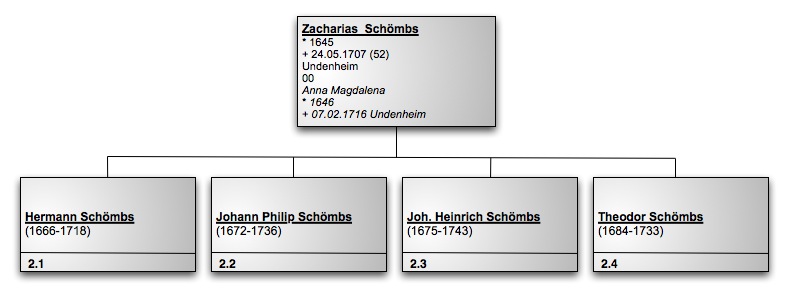
| I. Descendants of Zacharias Schömbs (1645-1707) |
| |
| |
Zacharias Schömbs (1645-1707) |
1. |
| |
|
Hermann Schömbs (1666-1718) |
2.1 |
| |
|
|
Maria Eva Schömbs (1694) |
2.1.1 |
| |
|
|
Anna Margarethe Schömbs (1695) |
2.1.2 |
| |
|
|
Joh. Mathäus Schömbs (1697-1772) |
2.1.3 |
| |
|
|
Anna Margarete Schömbs (1704-1774) |
2.1.4 |
| |
|
|
Anna Dorothea Schömbs (1706-1707) |
2.1.5 |
| |
|
|
Anna Sybilla Schömbs (1708-1712) |
2.1.6 |
| |
|
|
Katharina Elisabeth Schömbs (1710) |
2.1.7 |
| |
|
|
Johannes Schömbs jun. (1712-1780) |
2.1.8 |
| |
|
|
Joh. Melchior Schömbs (1715-1716) |
2.1.9 |
| |
|
|
|
|
| |
|
Joh. Philipp Schömbs (1672-1736) |
2.2 |
| |
|
|
Anna Barbara Schömbs (1710-1712) |
2.2.1 |
| |
|
|
Anna Magdalena Schömbs (1712) |
2.2.2 |
| |
|
|
Maria Barbara Schömbs (1714) |
2.2.3 |
| |
|
|
Joh. Peter Schömbs (1715) |
2.2.4 |
| |
|
|
Joh. Valentin Schömbs (1718) |
2.2.5 |
| |
|
|
Joh. Jacob Schömbs (1720-1724) |
2.2.6 |
| |
|
|
Maria Katharina Elisabeth Schömbs (1723) |
2.2.7 |
| |
|
|
Andreas Schömbs (1725-1796) |
2.2.8 |
| |
|
|
Joh. Jacob Schömbs (1727) |
2.2.9 |
| |
|
|
Servatius Schömbs (1730) |
2.2.10 |
| |
|
|
Maria Barbara Schömbs (1733) |
2.2.11 |
| |
|
|
Anna Margaretha Schömbs (1734-1735) |
2.2.12 |
| |
|
|
|
|
| |
|
Joh. Heinrich Schömbs (1675-1743) |
2.3 |
| |
|
|
Johann Schömbs senj. (1705-1766) |
2.3.1 |
| |
|
|
Anna Katharina Schömbs (1706) |
2.3.2 |
| |
|
|
Anna Maria Schömbs (1707) |
2.3.3 |
| |
|
|
Joh. Peter Schömbs (1708-1717) |
2.3.4 |
| |
|
|
Joh. Mathäus Schömbs (1711-1780) |
2.3.5 |
| |
|
|
Joh. Heinrich Schömbs (1713-1785) |
2.3.6 |
| |
|
|
Philipp Schömbs (1715-1717) |
2.3.7 |
| |
|
|
Andreas Schömbs (1718-1719) |
2.3.8 |
| |
|
|
Maria Katharina Schömbs (1720) |
2.3.9 |
| |
|
|
Joh. Georg Schömbs (1723) |
2.3.10 |
| |
|
|
|
|
| |
|
Theodor Schömbs (1684-1733) |
2.4 |
| |
|
|
Andreas Schömbs (1715-1767) |
2.4.1 |
| |
|
|
Joh. Mathias Schömbs (1717-1717) |
2.4.2 |
| |
|
|
Maria Elisabeth Schömbs (1719-1723) |
2.4.3 |
| |
|
|
Magdalena Schömbs (1722) |
2.4.4 |
| |
|
|
Maria Susanna Schömbs (1724) |
2.4.5 |
| |
|
|
Anna Catharina Schömbs (1727) |
2.4.6 |
| |
|
|
Joh. Adam Schömbs (1731) |
2.4.7 |
- Zacharias Schömbs is the oldest verifiable ancestor of our family. From the present day back to Zacharias, the family ancestry can be traced without gaps.
- In the first documented mention of Zacharias Schömbs from the year 1691 [1] the name was spelled "Schimpfs."
This spelling of the surname can have been of course accidental. It is not to be also ruled out, however, that this was the former writing-form of our surname. We think this is unlikely, however, since the name was written down "Schemes" in the books in all later documents between 1700 and 1710 with one instance of "Schömbs". It is speculated, therefore, that Zacharias and the family took on the spelling "Schömbs" after their arrival in Undenheim.
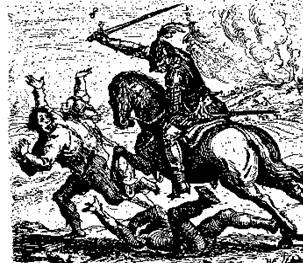
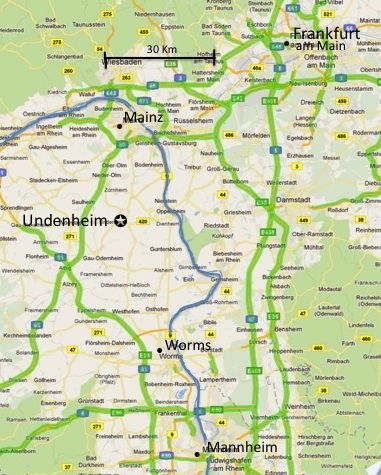
- Zacharias Schömbs and his sons were born in a century that was marked by almost continuous wars. The main-battlefields often lay within the Palatinate (the area west of the Rhine including Undenheim, Mainz and Worms, and what is today called the Pfalz). Wars, destruction, looting, hunger, epidemics and forcible death was the rule of the day making life and even survival difficult. Alone in the Thirty Year War (1618 - 1648) more than two thirds of the population was decimated and many villages and cities were leveled.
- As was noted in the record of his death [2], Zacharias had been born in the year 1645 -- during the latter part of the Thirty Years War.
-
- In the 1691 document referencing Zacharias Schimpfs is a mention of leaseholders from Stetten (near Kirchheimbolanden, a larger town 25 km to the southwest of Undenheim). The reference possibly suggests that Zacharias had come from Stetten. Stetten also had been devasted by war and lay in half. The biggest part of the village and the halls were plundered and destroyed by 1635. [3] Hardly had the city begun to rebuild, when it was again thrust into the war of Lothringisch in 1666, followed by the plague. Up to 50% of the then population perished.
Between 1673 and 1713, the Palatinate was the arena for several wars of the French king Louis XIV. (1672-1678 French-Dutch War, 1688-1697 more Palatine succession wars and 1701-1714 more Spanish succession wars). Especially devastating for the population of the Palatinate was the French general Melac in the year 1689.
- Bread and beer as well as coffee were the principle food staples of the simple population. The splendor in which the nobility lived, stood in the glaring contrast to the daily misery of life for the vast majority of the population.
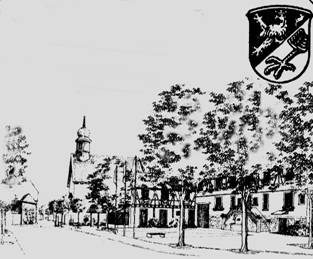 |
| Undenheim Marketplace with the Catholic Church |
- According to the protocol book of St. Alban, Zacharias Schömbs came in 1691 to Undenheim to take over at St.-Albans-Gut as Hofmann. The reference to this event in the protocol-book of St. Alban reads:
- "Herr Witberger Präbendamtmann..., dass Zacharias Schimpfs und Mathes Henn von Stetten Alzeyer Amts das Hofgut zu Undenheim ad interim bestehen und annehmen wollten, und seyen erbietig, davon zu entrichten erstlich dies Jahr für jeden besamten morgen gerst 1/2 Malter, sodan Habern 12 K. vom morgen; künftig 1692te Ernte aber für jeden morgen es sei Korn Gerst, Spelz oder Hafern 1/2 Mlr Korn zu entrichten. conclusum: Alderweiten man jetziger Zeit keine ander Hofleute haben kann, und dann viel besser sein wird, diese anzunehmen, als das Hofgut leer stehen zu lassen, so hätte Präbendamtmann denselben das Hofgut uff solche Weise zu übergeben."
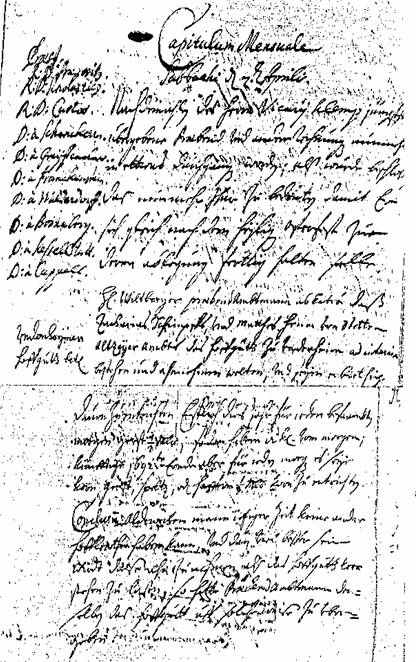 |
Excerpt from the Protocol Book of St. Albans
Granting the award of the Hof to Zacharias Schimpf |
- Note: With the assistance of Monica and Martin Schoembs of Nürnberg, we have the following translation.
- "Mr. Witberger (adminstrator for the Church),......that Zacharias Schimbs (Schömbs) and Mathes Henn from Stetten/District Alzey, want to take on the estate of Undenheim, and they are offering to pay first for this year for eash sowed Morgen (a Morgen was a former German measure. Originally it was the area of arable land a farmer could plow in a morning. 1 Morgen equaled 25,532 Ar. An Ar equaled a square metre); a half Malter (a former German measure of grain very different in size 100-115 litre or 115-274 litre) of Barley; and 12 K.(?) of oats for each Morgen. In the future for the harvest year 1692 they must pay for each Morgen a half Mlr (abbreviation for a Malter) of grain, barley, spelt or oats. Finally: because one can get no other farmers at this time, it would be much better to take these men (Schömbs and Henn) than to leave the estate unworked. So the Präbendamtmann (adminstrator for the Church) gives them the estate in this way."
- The word "Hofmann" translates to farmer. It was apparently a common word of the time, but not in use today. It will continue to be used untranslated through most of this work, as will the word "Hof" which means yard or farm.
- What persuaded Zacharias Schömbs to settle at St.-Albans-Hof in Undenheim is not known. He was already approximately 46 years old. The fact that he found the courage in the middle of the worst time of the Palatine succession-war to take on property is remarkable. Maybe it was even worse at his prior residence (presumably Stetten). Undenheim itself was deserted by many of its inhabitants. [4] The then Undenheimer Mayor Philipp Best had fled like many of the inhabitants to the Rechtsrheinische (east side of the Rhine). After the Mayor's second wife had died on the escape about 1690, he married the widow of the local school-master on 2 February 1691 in his third marriage in Trebur. The priest of Trebur noted: The reasons ....were these, that the wedding couple had escaped from Undenheim and the French invaders days before. [5]
- Zacharias Schömbs had a very difficult beginning in Undenheim, with not only the devastation from the war, but also an especially long and cold winter in 1691. Fruit trees and vines were frostbitten; still in May there was frost in the nights. Even the summer was bleak and rainy, resulting in a very minimal harvest outlook. The people in the ravaged countryside survived on peas, nettles, turnips, and herbs. Since the price of rye had ascended rapidly (1691 approximately 3 fl. l0 albs.) bread was completely absent from the tables of the poor. [6]
Again in the years 1692, 1694, 1695 and 1697 the winters were extraordinarily severe. Moreover the harvest was destroyed in 1694 by the French. For Zacharias Schömbs as well as others in the Rhineland life must have been a tremendous tribulation.
- The decision of Zacharias Schömbs in 1691 to go to Undenheim was also courageous, given the religious circumstances then in Undenheim. Zacharias Schömbs was Catholic. The predominant majority of the inhabitants of Undenheim was Protestant. Only 36 of the 317 inhabitants were Catholic. The few Catholics may have had a difficult social standing, given that Undenheim was somewhat of a Protestant island in the Palatinate at this time, and whatever the circumstances underwhich Zacharias came into control of the Hofmann's estate.
- In the hundred years between 1550 and 1650 as a result of the Reformation, there were eight changes of religion in the Palatinate as sovereigns changed. First the Palatinate had turned to the reformed beliefs of the Swiss Zwingli and Calvin. Each of these changes resulted in the replacement of all priests and schoolmasters, as members of the new faith were installed. The population was obliged to change their religious beliefs to comply with the dictate of the new sovereign.
Shortly before Zacharias Schömbs went to Undenheim, the Kurwürde in der Kurpfalz (a religious group) merged with the Catholic line in Pfalz-Neuburg. With this the Catholics gained new influence in the area. The other belief movements (Lutheran and reformed) were tolerated at this time at least. Inspite off their distinct minority in the population the Catholics gained preference on the basis of the changed political circumstances. This led to opportunities for them to take over public offices, which led to an influx of Catholic families into previously Protestant places.
Possibly these favorable prospects for the Catholic population were also the inducement for Zacharias Schömbs to move to Undenheim and to take advantage of the opportunity at St. Albans Hof. In our words, it may have been the right thing at the right time for Zacharias. Catholics, who came in the time of Zacharias Schömbs to Undenheim, became mayors, jurors, priests, shephards, Catholic teachers, court-reporters as well as farmers at St. Albans Hof.
- Many also became business people, for example bakers, blacksmiths, and butchers. Most did not remain farmers, like the Schömbs tended to do.
- It is not known whether Zacharias Schömbs, prior to his takeover of the Hofgut St. Albans, had a
relationship with the people in authority at the Cathedral in Mainz or the sovereigns in Heidelberg.
However, since the Schömbs family stayed in prominence at the Hofgut for virtually the entire 18th Century, this could not have been done without a very good relationship. The St. Albans Hofgut was the property of the Cathedral, one of a few large farms owned by the Cathedral, and produced food for its huge organization.
In addition to Zacharias, during this time the family produced not only four mayors in Undenheim, but also most of the managers/operators of St. Albans Hof. This farm of the cathedral, whose history reaches back into the 12th Century, is described later in the book in the words of Johan Heinrich Schömbs. Even today it is the biggest farm in the village and stands like it did 300 years ago at Tränkgasse No. 4 in Undenheim.
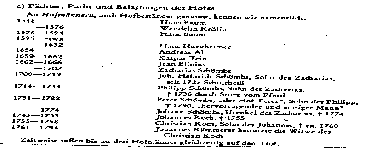 |
| Auszug aus Dieter Curschmann, St. Alban |
- Dr. Curschmann in his publication[7] describes St. Alban and the time between 1700 and 1800 appropriately as the century of the Catholic family Schömbs, who became one of the richest and most successful families in the village. The clever marriage politics of the Schömbs reinforced their hold on power and influence. There were connections to the Zöllers of the Electoral Palatinate from Wörrstadt, to the family of the village mayor at Dahlheim and with priviledged families in Undenheim (Kämmerer), Sörgenloch and Hahnheim. On a day in 1744 a double wedding took place between two Schömbs siblings and two siblings of the courtiers' family Dapper from Sörgenloch. Finally there were three marriages in Undenheim to the Lahr family (a juror), whereby 1793 and 1798 grandchildren of siblings married each other, creating a relatively close relation of the third degree.
With the end of the Electoral Palatinate in 1803 the power position of the Schömbs at Undenheim came to an end. This turning point brought not only the end of the mayoralty but also the end of the Catholic control. After the French authorities auctioned the estate of St. Alban to a private owner, it was the end for the last of those who had been priviledged to live and work at St. Albans.
By 1900 the Schömbs surname had died out in Undenheim. Descendants of Zacharias by way of females with married names were plentiful. They still owned property and lived in Undenheim (e.g. the home at Schulstraße 6). But the family had lost its influence and the Catholics' situation was worsening. The Schömbs family who had had a dominant position in Undenheim for nearly a full century undoubtedly had found the changes very difficult. Having been in control for so long, members of the Schömbs families might have been unpopular in the village. It might be a reason the family left one after the other to different places and the Schömbs surname does not exist today in Undenheim.
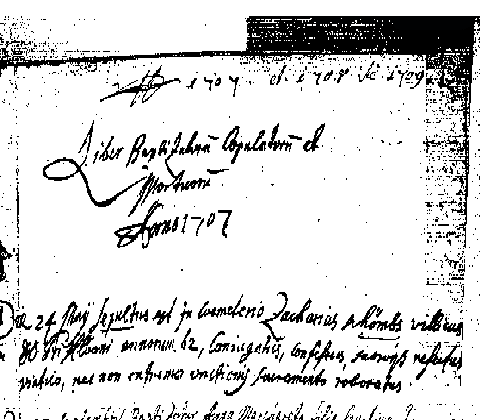 |
| The Undenheim Churchbook entry of the death of Zachararias Schömbs (1707) |
- Whether Zacharias Schömbs had siblings is not known. We know of four of his own children, those who came with him to Undenheim. Presumably these were the only children – all sons. Of Zacharias' sons, only about Theodor is little known. He lived in Gabsheim, about 4 km. (2 miles) to the southeast of Undenheim.
- The other three sons, and their children, produced large families (although normal for the time) and ensured the expansion of the Schömbs surname. Hermann Schömbs, who by 1707 had already become the first of the Schömbs mayors of Undenheim, had 9 children.
- Joh. Philipp Schömbs, successor of Joh. Heinrich Schömbs as St. Albans-Hofmann, had 11 children. We know that Joh. Philipp died as a result of the fall of a horse. One of his sons, the so-called "Hof-Peter" then became his successor as St. Albans-Hofmann. Dr. Curschmann, in his publication about Undenheim, mentions "Hof-Peter" as "an especially outstanding and industrious man."
- Another son of Joh. Philipp, Valentin, born in 1718, would later become the priest in Friesenheim, 4 km to the east of Undenheim. Because of the distances to the cities, there were for the inhabitants of Undenheim in the earlier times few opportunities for formal education or promotion in one's career. Valentin Schömbs was one of the few exceptions. He probably profited from the good relationships that his father as the operator of the Cathedral's farm (St. Alban) had with the hierarchy of the Cathedral in Mainz. This enabled Valentin to attend school and study at the Cathedral.
- Joh. Heinrich Schömbs, who also served as mayor of Undenheim, had 11 children as well. From him came the Laubenheimer line (Schembs), a part of the Herrnsheimer line (Schembs) and the Oppenheimer line (Schömbs).
- In conclusion there are some additional comments regarding the times in which Zacharias Schömbs lived. We have already mentioned the Thirty Years War (1618-1648), as well as the destruction of the Palatinate in 1689. The worst epidemic of the Middle Ages, the plague, was still taking its toll. One of the predecessors of Zacharias Schömbs in his role as Farm Manager, Jean Blinius, had died in 1666 of the plague. The superstitions and witchcraft of the Middle Ages, that had their climax in Germany between 1500 and 1700, were still reality. Almost one million people fell victim as a result of superstitions and the resultant persecutions.
- Zacharias Schömbs belonged to the peasantry. As leaseholder of the Hofgutes of St. Alban, it might have gone better for Zacharias than for the multitude of other farmers; nevertheless the reality was that he was a farmer and farmers were looked down upon by many others in the in the society, not just the nobility. Their services were required to fight the continuous wars, yet they still had the burdens of trying to maintain their farms with the debts and other burdens that this entailed. The agreements under which the farmers worked their farms for the landowners took little notice of the burdens and circumstances under which they lived. Even marriages were dependent upon the permission of the landowner. This totally dependent relationship between farmer and landowner began to slowly vanish after the French Revolution (1789).
- The technical developments of the Middle Ages had not yet had an impact upon the German farmer – tools, machines, motors were a long way off. Power was supplied by the farmer's back and his horse.
- Some of the famous contemporaries of Zacharias Schömbs (1645-1707) were:
- Rembrand (1606-1669)
- Jan Vermeer (1632-1675)
- Isaac Newton (1642-1727)
- Ludwig the XIV (1643-1715)
- G.Wilhelm von Leipniz (1646-1716)
- Matthäus Merian (1647-1717)
- Lieselotte von der Pfalz (1652-1727)
- FOOTNOTES:
- [1] siehe Anm.11
- [2] Kath. Kirchenbuch Undenheim 1707 (siehe Abdruck auf Seite 11)
- [3] Kath. Kirchenbuch Undenheim 1707 (siehe Anm. 12)
- [4] Dieter Curschmann, Von der Frankenzeit bis zur Franzosenzeit, kleine Geschichte Undenheims
- [5] Auskunft Dieter Curschmann vom 20.04.1985
- [6] W. Rödel, Mainz und seine Bevölkerung im 17. und 18. Jahrhundert, Seite
235 ff
- [7] Dieter Curschmann, St. Alban, Alzeyer Geschichtsblätter, Heft 10, 1974
-
|
|
|