|
- Introduction
- 2. The Family Name Schömbs / Schembs
(Origin, Meaning and Migration)
- 2.1 General Introductory Remarks on the Formation of Surnames
- Most surnames in Europe originated in a time when the majority of the population could neither read nor write. Life was carried out in a small local framework, and a Christian (given) name was all that was required to keep people straight.[1]
First surnames developed slowly in Germany during the Middle Ages between 1300-1600. They originated from large groups of given names (e.g. Dietrich, Rüdiger), from occupation names (e.g. Müller (Miller), Bäcker (Baker), Weber (Weaver), Schneider (Tailor), Schmied (Smith) and ancestral names (e.g. Ambach, von der Aue, Darmstadt). In the case of craftsmen, sometimes the name of a detail of the craft became the surname, for example the Schmied (smithy) might become "Funke," or "Hammer" (Spark or Hammer), the Metzgern (butcher) "Kalbfuß" or "Kalbskopf" (calves foot or calves head) or the Bäckern (baker) "Butterweck".
Another big group took names that were descriptive of their physical or personality characteristics. Still other names originated from the preferences of the individual to certain things, clothes, etc. First these were sometimes nicknames, but later became the surname. Particularly with nicknames, people used imagination and took on powerful and glowing names. As one looks at the choice of surnames this becomes clear:
- Weiskopf, Weishaupt, Schönhaar, Siebenhaar, Hasenkopf, Hasenfratz, Eisenkopf, Roßkopf, Hühnerkopf, Bertzel, Breitkopf, Schönhals, Kurzhals, Krähahn, Saufaus, Schönbein, Kalbfuß, Kuhfuß, Streckfuß, Holzfuß, Schienbein, Seidenfuß, Hasenfuß, Tischbein, Kümmelbein, Schuhriemen, Pfannstiel, Hufnagel, Stoppelbein, Dickhaut, Ziefuß, Fingerhut, Wirsing, Saueressig, Sauerwein, Dotterweich, Eiermann, Süßmilch, Erbsmehl, Butterfaß, Butterweck, Fettbak, Rindfleisch, Roggenbrot, Hartnuß, Weisbrot, Brotback, Haferkorn, Kuchenbäcker, Metzger, Wurst, Butterbrot, Bierschenk, Schluckebier, Müßiggang, Ochs, Ochsenreiter, Schwein, Hundgeburt, Grasmück, Nußbaum, Baumsteiger, Holderbaum, Oberbillig, Steinbrech, Kaltwasser, Rebstock, Ofenloch, Siedetopf, Stubenrauch, Schaumlöffel, Löffelholz, Klotzbücher, Hammerschlag, Hausladen, Frühauf, Gutjahr, Unruh, Edelblut, Liebling, Liebeskind, Schätzlein, Glückselig, Gottselig, Heilig, Gottlöber, Frauenknecht, Bauernfeind.
Or in English: White head, beautiful hair, seven hair, rabbit head, rabbit's face, iron head, horse's head, chicken head, broad head, beautiful neck, short neck, crow, booze, beautiful leg, calf's foot, cow's foot, splayfoot, wooden foot, shinbone, silk foot, rabbit's foot, table leg, caraway leg, shoe-strap, panhandle, hoof nail, stubble leg, thick skin, pulling foot, thimble, savoy cabbage, sour vinegar, sour wine, soft yolk, egg man, sweet milk, pea flour, butter churn, butter bun, beef, rye bread, hard nut, white bread, bread baking, oat grain, cake baker, butcher, sausage, buttered bread, beer tavern, swallow beer, idleness, ox, ox rider, pig, dog birth, warbler, walnut tree, tree riser, holder tree, saxifrage, cold water, vine, oven hole, boiling pot, house smoke, skimmer, spoon wood, hammer blow, house shop, early morning, good year, restless, noble blood, darling, love child, sweetheart, blissful, god blessed, holy, god praise, woman's servant, peasant enemy.
Surnames were often awarded by fellow men who were not cautious or delicate in their decisions. Apparently the recipient was obligated to accept even the unflattering name. Especially extreme seems to be the case of the family "Arschloch" (arsch means arse, or butt and loch means hole), but to show their sense of humor they incorporated the spirit in their family-coat-of-arms.
| The Crest of the Familie Arschloch |
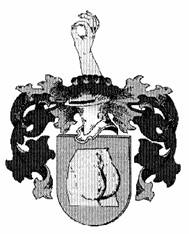 |
Description of the Crest:
In gold, a naked flesh-coloured backside in a straight position. On the red-gold bulging helmet, growing with red-gold blankets, a flesh-coloured arm, thumb and forefinger of the hand closed to a ring.
|
- In 1437 in Frankfurt am Main in the courtbook a "Meister Nikolaus Arsloch" is mentioned. In another document we find from 1461 a "Clese Arsloch, Krämer" (grocer). Still one more from 1462 shows a "Clas Arsloch et uxor", in the work: "Deutsches Bürgertum im Mittelalter" (German Bourgeoisie in the Middle Ages).
As a crude swearword "asshole" is still very common in High German. "Arsch" is a pejorative name through the ages for unworthy people. So "Hans Arsch of Rippach" occurs with Goethe in "Hanswursts Hochzeit". But the name is found earlier in "Trömers Toucement" . Further examples are: Albert "arshar" 1444 in Hannover; Bernd Vul-ars 1489 of Hamburg; adapted through dialect, Johann Pagen-ers 1309 in Soest;, Düvels-ers 1385 in Rostock; Clowen-ers= kratz den Arsch", in the 14th Century in Lübeck."
For those who think they have inherited an embarrassing family name, they should remember this example. Things could be worse!
At first the surnames were passed along mostly orally. If the necessity emerged to put the name in to writing, for example in contracts, court-protocols, inhabitant listings, and churchbooks, they were written by those few people who could write to one extent or another. People were depended upon to know how to spell their names. Misunderstandings occurred, especially if there were dialectic peculiarities or if the names had foreign origins. It is understandable, therefore, when the surname was later written by a different scribe that it was written differently.
Also it was not until the time of Konrad Duden (1880) that uniform rules were established for orthography, ending the practice of fashionable changes of names.
Typical in the 18th Century was the usual practice of the award of the "Leitnamen“ (lead name). Especially popular, including with the Schömbs as well as Schembs, was to give each male child the given name "Johann". This was then followed by his actual name, for example "Johann Heinrich". It should be guaranteed that a Johann continues the family tradition of the father.
- 2.2 Meaning and Origin of our Familyname
- To learn the meaning of our surname, I approached the Gesellschaft für deutsche Sprache (Society for the German Language) in Wiesbaden in 1983. The family name Schembs, along with Schemp, Schempp, Schempf, Schems und Schimpp all come from the Middle High German.[2][3] The name goes back to the Middle High German "schimphaere", "schemphaere", "schimpfaere" which also mean "braggarts" or "mockers" like joke-makers, jesters, and so forth.
Possibly the first form of our family name could be "Schemph," or "Schimph,", etc. In the Middle High German, therefore, we were named for humor, joking, or games in the age of chivalry. In the Middle Ages the meaning of "Schimphen" was to joke or to play, fighting as a pastime, but to mock or poke fun at somebody also. "Schimpherie" meant joke or feast (banquet). A "Schimpfhus" therefore was a house for playing and entertainment. The medieval "Schimpf" is not the same as the "Schimpfen" of present day German (meaning to scold). With "Schemph," "Schimph," etc. in former times one described an openminded, sociable, friendly person, who liked pastime and joke as well as mockery and boasting. Apparently these characteristics were well pronounced among our forefathers and our surname follows from that.
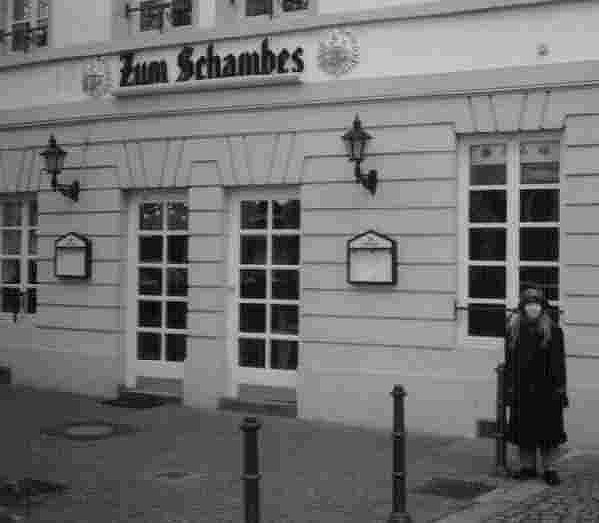 |
| Restaurant "Zum Schambes" in Mainz |
- Otto Schembs, Frankfurt, independently did his own research on the meaning of the family name.[4] It suggests that the name goes back to the Rheinhessen and also the Palatinate with the original spelling of "Schambes". Also in a letter from 1953 from Franziska Schoembs (Offenbacher Line) to Jaques Schoembs, Heidelberg, the same theory is postulated.
The origin for this nickname reaches back into the beginning of the 19th Century and the time of the French. During this time the French given name "Jean Baptiste" was popular and widely used. "Schambes" is the Rhein-Hessen dialect-form of this French first name.[5] Thus "Schambes" became an original name for a Mainzer and was used in many jokes. Even in the State Theater in 1975 was presented "Schambes, de Prinz von Mainz".[6] In the old part of Mainz (Augustinerstraße) there is a restaurant "Zum Schambes".
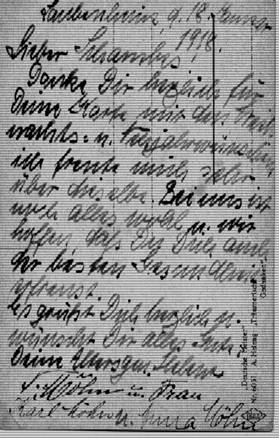 |
Christmas Card from the year 1918
with the Salutation "Lieber Schambes" |
- The use of the name "Schambes" was common, as is seen on the right in the New Years greeting card from the year 1918.
The use of the name "Schömbs" as well as "Schembs", however date back prior to the arrival of the French, so that a possible connection of our surname to the "Schambes" can undoubtedly be discarded. It appears to be only a similarity with no genealogical relevance.
One who in their youth was a diligent reader of Karl May, and read his novels about Arabia (e.g. Durchs wilde Kurdistan), could find in several places the name "Schems" (El Schems). Karl May used this Arabian name often in his work. The Arabian author "Muhammed Schems ed –Din Haf", born in 1326 in Schiras wrote the book "Der Diwan" (the Divan).
Also in an article about "The history of coffee" the name appears. "….1554 the two merchants Hakin of Aleppo and Schems of Damaskus founded the first café on European soil at Constantinople…."
- The above explanations of the meaning and origin of our family name require a new consideration since 2020.
In the radio programme of the Südwestfunk (SWR1), listeners have for some time been able to obtain information about the origin and meaning of their family name under the keyword "Your name on the radio". Reinhold Schembs had also "applied" for this. On 20.05.2020 he had the opportunity to talk to the onomastics professor Jürgen Udolph about the origin of the family name.
Regarding the origin of the family name, Prof. Udolph referred to a source from the year 1938, in which he found the decisive hint for him. The source to which his information referred was a publication by Johannes Frey (1938): Heiligenverehrung und Familiennamen in Rheinhessen. On page 22 it says: "In many places Johannes Baptist is trivialized to Schambes. One might therefore be tempted to count the surnames Schömbs 1650 in Undenheim, 1807 in Hessloch, Schömingen and Schömig 1752 in Planig and Schemes 1700 in Pfaffen-Schwabenheim here. But they go back to "Sconibert", Schönbart 1494 ".
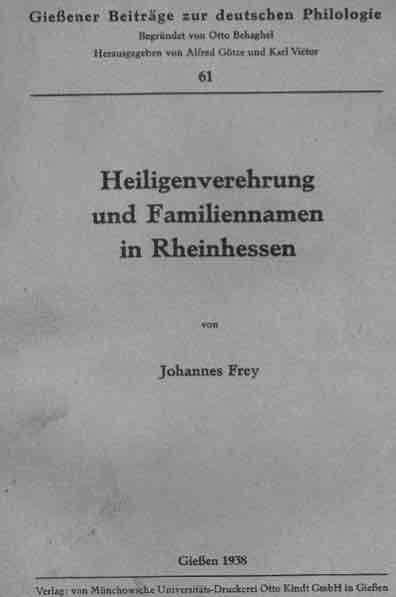 |
Veneration of Saints and Family Names
in Rheinhessen
Click to enlarge |
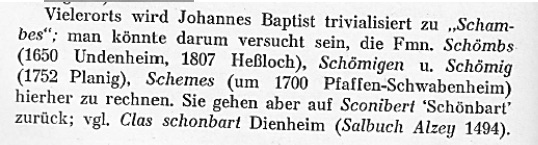 |
Excerpt from page 22:
Click to enlarge |
- The origin and meaning of the name "Schönbart" or "Schembart" are explained in the relevant works and dictionaries (e.g. Gebrüder Jacob und Wilhelm Grimm, 1893, Brockhaus, Digitales Wörterbuch der deutschen Sprache, Handwörterbuch des deutschen Superstubens, Mathias Knobloch, 1932, etc.).
What is certain is that the original spelling and meaning goes back a long way, probably between 1300 and 1500. ""Schönbart“(nice beard) or "Schenbart" "Schembart", then in further variants such as schonpert, schömpart, scheinpart (16th century) goes back to the Middle High German "schem(e) bart, (with larva, masked appearance", and meant face mask or larva), Schemen ('mask beard'), Early High German schemper (15th century), later an adaptation to more known words followed. As a result, the folk etymological reinterpretation was to schöne part (15th century), Middle High German sconebart, Schönbart.
Finally, it can be stated that the name "Schönbart", which is attested as a family name as early as 1494, goes back to the ancient term for mask, larva, possibly mask with integrated beautiful chin beard. The former medieval spelling "schem (e) bart" was adapted to modern times and became "schönbart". Inseparably connected with the origin of the name is the earlier mask activity, which has been handed down from the Middle Ages. The custom is especially and until today preserved in Nuremberg. There, the so-called "Schönbartlaufen" or "Schembartlaufen" has existed since 1449 and was originally reserved for the butchers' guild. The custom is still maintained in Nuremberg today.
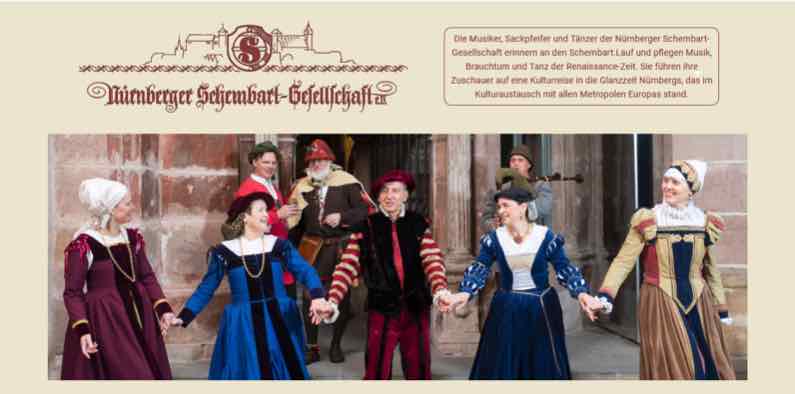 |
Schembart Society of Nürnberg
Click to enlarge |
- What does this new interpretation of the origin of the name mean for our family name Schömbs or Schembs? One will probably have to consider two possible explanations.
If one goes back to the medieval origin of the term for "mask, larva with beard", our ancestors could owe their name directly to the perhaps particularly distinctive active wearing of such a mask or larva".
However, at a later time, i.e. after the reinterpretation into Schembart-Schönbart, the name could actually have been used for a contemporary with a beautiful beard, i.e. according to the German meaning for this word (man with a beautiful beard).
Both are conceivable.
The previous explanation of the family name, which is said to be based on the medieval "Schempp, Schimpf", which in the Middle Ages meant "joke, game, mockery", but in any case also shows the clear "kinship" to the new explanation. In both cases, the same or similar characteristics and activities of the name bearers form the basis of the explanations.
"Play, dance and fun" are characteristics that can undoubtedly also be associated with "bearded running", masked running and carnival activities. A close "relationship" between these two explanations is therefore strongly to be assumed.
In the publication by Johannes Frey, in which he mentions the occurrence of family names in individual Rhine-Hessian towns, the year 1650 is conspicuous in relation to the Schömbs family in Undenheim. It is not evident how he came to this date. Perhaps it is a mistake or he had an unknown source for it. In any case, all research carried out so far could not provide any indication that the family had been in Undenheim before 1691/1692. If the date 1650 were correct, the family would have been in Undenheim for 40 years and the forefather of Zacharias Schömbs might even have been born there in 1645. In the time around 1640, thus still at times of the 30-year war Undenheim was probably completely uninhabited. Only in 1650 the first homecomers came back to Undenheim as the reformed church book of Undenheim shows. Members of the catholic Schömbs family are not recorded in it and are not otherwise known. In the first two decades after 1650 there was a very strong fluctuation of the population. Some came to the Palatinate to settle in the depopulated land, but often moved on again. But even in the second half of the century there was no rest. In 1665/1666 the people of Lorraine lived in the country; the population had to flee. In addition, the plague killed 61 inhabitants in Undenheim. In the mid-1670s French troops devastated the Palatinate. Again the inhabitants of Undenheim were on the run. In 1680, fields, meadows and vineyards in Undenheim were still desolate. Even worse came the Palatinate War of Succession 1689-1695, when the Reformed Church Register completely lacked entries from this period. Once again, the inhabitants of Undenheim fled the devastation, mostly to the right bank of the Rhine, but some also to the Lower Rhine, from where numerous settlers had come to the Palatinate in the preceding decades.
As a result of the acts of war in these troubled times, there are few records of the population. Destruction and plundering did the rest.
In the very detailed local history of Undenheim by Walter Schwamb all known Undenheim inhabitants are listed, also the names of the "original inhabitants" appear there. The Schömbs are not mentioned before 1691. It is therefore very unlikely that the family was actually in Undenheim as early as 1650.
Therefore it is more likely that there is an error in the 1650 information.
- 2.3 Different Spellings of the Family Name
- In the first Edition of the family chronicle it was pointed out that the surname Schembs was limited to southwest Germany and particularly around the cities of Mainz and Worms.
Since the beginning numerous spelling variations of the name were found. Perhaps the oldest variation (if it is related) comes from Mainz. There in a document dated 15 September, 1330, is mentioned a ein "Emerchone dictus Schempe" as councilor.[7]
A similar spelling is seen in a Mainz document from the year 1691. Beside the entry which records the information about "Zacharias Schimpfs" is a reference to a "Vicarii Schemp"[8]).[8] Also from 1691 is a different document with a similar sounding surname, "Paul Schemb" from Lampertheim. Schemb participated as godparent in the Protestant baptism of a Paul Clotz. The father of the child being baptized, Johann Peter Clotz, came from Worms and the mother, Anna Salome Beyer was from Lampertheim.[9] There is no reference that suggests a connection of these names to ours, however, and any further thought would be pure speculation. In examining an old listing of inhabitants of Mainz, there was nothing to infer a relationship.
Otherwise there is the second tabulation containing the name "Schemes" in the context of "Kassel". Here several things speak for an affiliation with the family Schömbs/Schembs. First is the spelling of "Schemes" and then "Schems".[10]
Then is the clear reference in Rhine-Hessen to Zacharias Schömbs und Hermann Schömbs and the use of the spelling "Schemes".[11]
According to the information from the researcher Dr. Curschmann on 11 April, 1987, he determined the following name spellings:
| Inhabitant table from 1695, from the priest produced |
Schems |
| A written tabulation by the Palatinate overseer office in 1698 |
Schemes |
| Evangelisch Parish protocol from 1695, and later in a contract dated 1715 |
Schems, Hermann |
| Catholic churchbooks of Undenheim (between 1754 and 1781) |
Schems |
| Catholic churchbooks of Undenheim (in the years before and after) |
Schömbs |
- Name Spellings found since the beginning of the research:
| Kassel |
Anton Schemes and daughter Wilhelmine Friederike, 1742 |
| Carlshafen/Weser |
Anton Schems, Hausfourier (servant or civil servant working in a certain area) from Kassel, died 18.12.1757 at the age of 98 |
| Darmstadt |
Johann Georg Schemes, Kammerfurier (Hofdiener) zu Darmstadt (1770) |
| Gabsheim |
Johann Adam Schems, 1766 according to emigration documents for Hungary |
| Offenbach |
Hans Schömbs 1943 pedigrees through Otto Reichert |
| Undenheim |
Zacharias Schömbs 1707 died in Undenheim at the age of 62 (identical with Zacharias Schimpfs as well as Zacharias Schemes, see above) |
| Wo-Herrnsheim |
Henrich Schembs, master barrel maker, son of Henrich Schembs from Undenheim (married 28.1.1738 to Catharina Elisabeth Holtzemer)
Gertrud Schembs, daughter of Henrich Schembs, Herrnsheim (married on 7.8.1785 to Johann Peter Schmitt)
Andreas Schembs, Widow, baker in Herrnsheim (married on 8.4.1777 to Anna Maria Götz) |
- Furthermore the following name variations are known from Herrnsheim:[12]
- Schemß
Kristoph jun., 26 years, plowman
Karl, 56 years, plowman
Valtin, 59 years, day laborer
Kristoph, 44 years, day laborer
Mathes, 35 years, plowman
Philipp, 56 years, plowman
Katharina, 57 years, widow
Jacob, 24 years
In 1849 Mathias Schömbs, a farmer with seven children emigrated from Herrnsheim to Amerika.
In Worms (Herrnsheim) the spelling "Schembs" was also widely used.
- As mentioned above there was an entry from 1760 in "Hof-Stands- und Staatskalender 1760 des Fürstlichen Hofstiffts Würtzburg und Hertzogthum" Francken" (Princely Court Abbey Würtzburg and Duchy Franconia) with the name Johann Valentin Schoembs, "Wintzenhofen" (today Winzenhofen in Baden-Württemberg). The result of inquiries about the origin of Johann Valentin Schoembs was that he is a son of Johann Philipp Schömbs born in 1718 in Undenheim. He became a priest and emerged in 1756 at Herrnsheim, the later residence of his brother Andreas as his groomsman as well as godfather of Andreas' son Valentin.
- A summary then of the various spellings for the family during the late 17th, 18th and 19th Centuries in Germany would be:
| Schemes |
Schimbs |
Schempe |
| Schemß |
Schimpfs |
Schemp |
| Schems |
Schömbs |
Schemb |
| Schembs |
Schoembs |
Schempp |
- Whether Schempe, Schemp, Schemb, Schempp belong to our family is either unknown or doubtful.
- The surnames with the present day spellings (Schömbs, Schoembs, and Schembs) appears frequently in Southwest Germany, particularly in the Rhein-Hessen region between Mainz and Worms.
Clearly around 1700 the variations in the spelling included "Schimpf", "Schems", "Schemes" and "Schömbs". "Schömbs" and in individual cases "Schoembs" are well established in church books and later on in the books of the register offices. Then in two of the major cities (Herrnsheim and Laubenheim) is the change to "Schembs". In America there are other variations of the name with "Schambs", "Schombs" and even "James". All these names date back to our family unambiguously.
Some time ago a branch of the family was found surprisingly, which writes their name "Schems" – without "b" – the same as can be found in some old church books.
This family is "Russlanddeutsche" (ethnic Germans who emigrated to Russia). The family returned to Germany a few years ago and lives now in Bad Sachsa. Contacts with Elfriede Schems (*1924), her son Helmut and grandson Vladimir gathered much information. All of them speak the typical "Russland-Deutsch" but understand German very well. According to Elfriede her parents and grandparents lived in Russia. In the early 1920s the family returned briefly to Germany where Elfriede (*1924) was born. In 1927 they returned to Russia, living first in the Caucasus and later in Kazakhstan after the displacement by Lenin. Elfriede's father was a foreman of an agricultural "kolkhoz." Elfriede and her chlldren did not know from where in Germany the family had originated. One can only speculate about from where they came. It might be that they are descendants of Johann Adam Schems from Gabsheim, who planned to emigrate to Hungary in 1766. Possibly he changed his mind or the family went later from Hungary to Russia.
Maybe they descend from Rhineland (today Westphalia). There the family name "Schems" is documented at Soest as long ago as 1655. To trace this line into Russia is not possible today.
As recently as 1997 a further user of the name "Schems" lived in Bürstadt, namely "Reinhold Schems". Unfortunately his trail has been lost. His origin is suspected in the same line.
The spelling "Schems" is also found on a Brazilian website (BRAZILGENWEB). A list of Immigrants of 1826 shows the variant "Schömbs" and as well "Schöms". More information about Thomas Schömbs, emigrant to Brazil, can be found in the book by Jim Schembs "Die Auswanderer Schömbs." The descendants of Thomas Schembs/Schömbs spell the family name Schemes and have for many generations.
We know also about Johann Georg Schömbs (*1801 Hahnheim), married to Theresia Horn. Originally they contemplated emigrating to Brazil, apparently did emigrate to Algeria, and returned from Algeria after a year or two to then emigrate to Amerika and settle in Brooklyn NY. Their family name changed to Schombs, one of two branches in the world using this spelling.
As mentioned above variations from the original surnames often resulted from lifes events. But we also know of cases where a different spelling followed from conflicts within families, for example about inheritance matters. Family members used deliberately different spellings of the family name to distance or distinguish themselves from the unloved relatives. A change of the family name for such reasons is hardly practicable nowadays.
Sometimes emigration, or rather immigration into the new country, gave rise to changes in spelling. In America German names often were "Americanized". On one hand this was for practical reasons, but it was sometimes pressure onto the persons of German origin during the World Wars. We are aware, however, of no Schömbs descendants who changed their names during or following the World Wars.
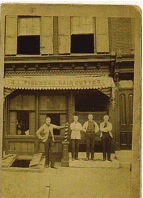 |
Foto ca. 1890: Figenshu George L., barber, 2216 Market Street
The lettering on the Awning states:
G.L. FIGENSHU. HAIR CUTTER |
- In America there were other rather odd reasons for changes in spelling of names as the following anecdote about "George Lawrence Fiegenschuh" shows. His father emigrated to America from Alsace in 1840.
Fiegenschuh worked as a hairdresser at Peter Schembs' barber shop in Philadelphia. Later he took over the business from Peter Schembs. The barber shop was located in a narrow house. As Fiegenschuh took over the business and wanted to attach an awning with his name over the entrance, he recognized there was not enough space at the marquee for his long name. He shortened his name without further ado and dropped three letters ("Fi(e)gens(c)hu(h)"). Since then the family's name is like the logo at the marquee " F i g e n s h u ". The Figenshus were friends and business associates of the Schembs but not related.
- 2.4 Occurrence and Distribution of the Name in Germany
- For the second Edition of my chronicle I was able to make use of a CD of the present German Telephone book [13] with the addresses in all of Germany. With this latest Edition I include information showing the spread of the name as of 1995, at least as far as telephone listings can be of help:
| German State |
Telefon Book Entries |
Schömbs
Entries |
Schoembs
Entries |
Schembs
Entries |
| Rheinland-Pfalz |
63, 80 |
28 |
|
44 |
| Hessen |
58, 59, 60, 61, 62, 64, 77 |
20 |
2 |
13 |
| Baden-Württemberg |
76, 78, 83, 86, 89, 90 |
13 |
|
|
| Bayern |
94, 99, 100 |
3 |
2 |
5 |
| Nordrhein-Westfalen |
36 |
3 |
|
|
| Berlin |
1 |
3 |
3 |
|
| Niedersachsen |
13, 20 |
2 |
1 |
|
| Schleswig-Holstein |
3 |
1 |
|
|
| Total Entries (143) |
73 |
8 |
62 |
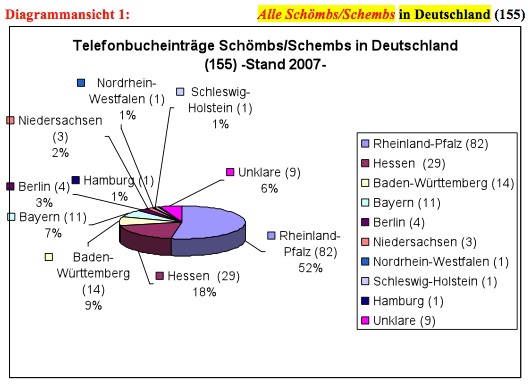
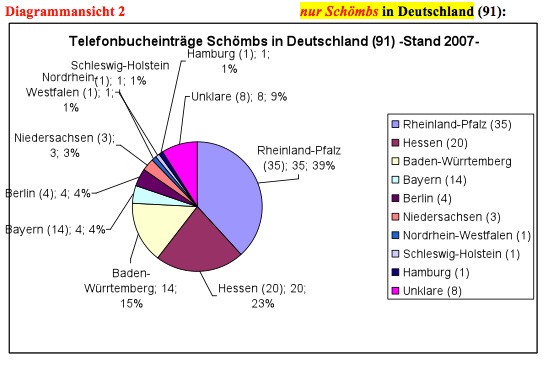
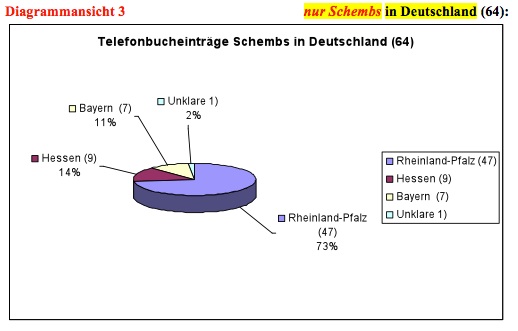
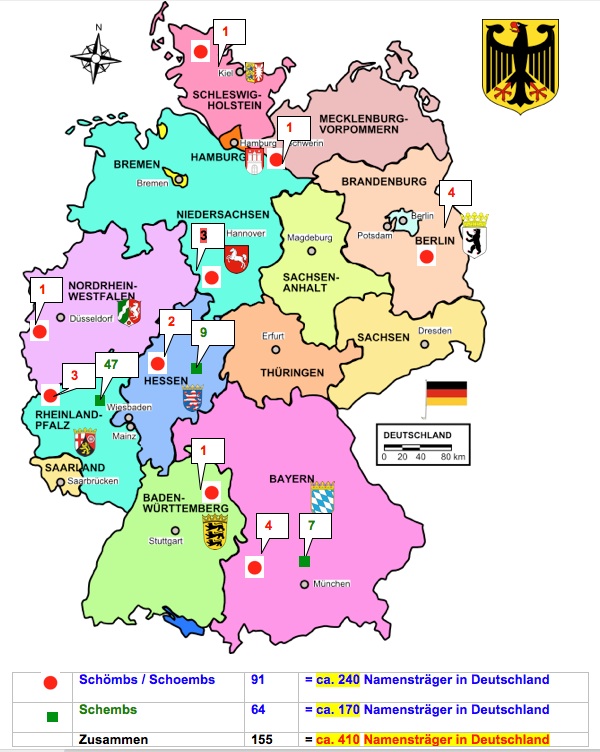
| From this overview one can estimate that there are perhaps 400-500 persons living today in Germany with the family surname variations known. This assumes that a household has on average three persons, and that some families still exist without telephones or listings. A listing from 2007 shows no significant change. |
 |
 |
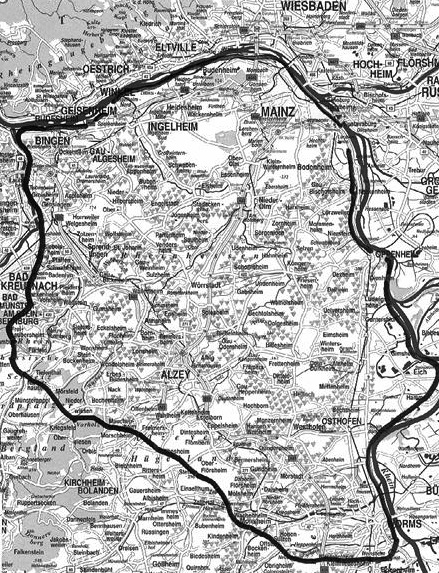
Map of Rhineland-Palatinate
(with core area of the Rheinhessen family) |
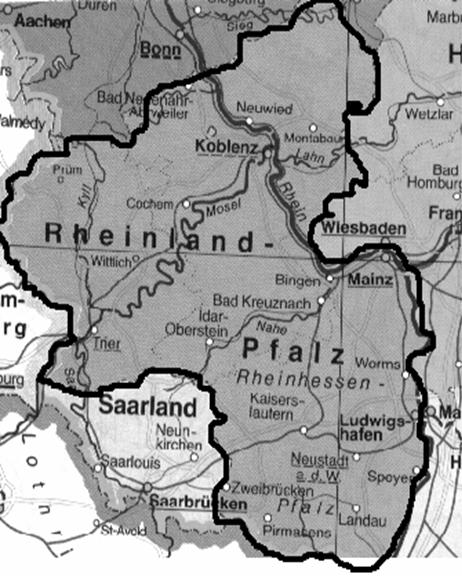
Map of Rhineland-Palatinate
(with the most important family locations Undenheim,
Laubenheim and Herrnsheim) |
- The following pie charts present the 2007 data of the spelling variations:
-
-
-
- Combining the phonebook data gives us a map of Germany showing the distribution of family members:
-
- With the research done by Jim Schembs of emigrants to the United States and other countries, we can similarly estimate family members outside Germany. In 2007 there were 97 entries in the U.S. phone directories. However with more people having unlisted numbers or only cell phones we should use a somewhat higher multiplier. We know this because we can look into the chapters of Jim Schembs' book. In the United States there are between 500 and 800 people with one of our family surnames. Brazil is somewhat more challenging to contemplate. We know of perhaps 100-200 family members. However many Brazilians do not have listed phone numbers. In other countries, e.g. France, Canada, Netherlands, Austria, Taiwan, Switzerland and so forth, the numbers are maximum of 5-10 for each. But all of this is only looking at spelling variations of Schömbs. When one considers those relatives who descend from Schömbs women whose names changed through marriage, you can double the numbers.
The distribution of family members in the United States is shown in "Section 5: Emigration of Schömbs / Schembs Family Members to Amerika".
- Distribution of Schömbs (including variations) telefon book entries around the world:
-
- In total, there are probably over 1000 people in the world with the surname Schömbs and its spelling variations, with the vast majority being in Germany, Brazil and the United States.
- FOOTNOTES:
- [1] Laubenheimer inhabitant list from the year 1551 "Die Einwohner des Kurmainzischen Amtes Olm 1551-1554 "Paulus von Durtzweyller, Hanns von Castel, Gerhart von Hexheim"
- [2] Information society for the German language: Auskunft der Gesellschaft für Deutsche Sprache, Wiesbaden, vom 09.08.1983
- [3] see also Brechenmacher, Etymologisches Wörterbuch der Deutschen Familiennamen sowie Heintze-Cascorbi, Die.deutschen Familiennamen for the meaning of the familynames Schemp(p), Schempf bzw. Schimp(p)f
- [4] letter from Otto Schembs (1901-1972), Frankfurt, in the year 1965 to William Wayne Schembs, USA, cited in
"Study of all the Schembs immigrants to America, their lives, and their descendants" by Jim Schembs, USA
- [5] see Kart Schramm, Mainzer Wörterbuch, Erläuterung des Dialektworts "Schambes". Also in the "Rheinhessischen Volkskunde" by Wilhelm Hoffmann, page 167, is mentioned "Schambes" as a translation of the name Johann Baptist.
- [6] see Roesgen-Gierlichs, Das Mainzer Volksbuch, page 175
- [7] see Auskunft der Gesellschaft für Deutsche Sprache, Wiesbaden, from 09.08.1983 and Brechenmacher, Etymologisches Wörterbuch der Deutschen Familiennamen sowie Heintze-Cascorbi, Die.deutschen Familiennamen for the meaning of the familynames Schemp(p) , Schempf bzw. Schimp(p)f.
- [8] see Chapter B "Die Undenheimer Schömbs, Zff.1 Protokolbuch St. Alban, 1691, Pachtvergabe to Zacharias Schimpfs,
- [9] information from the Evangelische Lutheran congregation churchbooks, Lampertheim from 17.10.1984
- [10] as mentioned in Footnote 2 of Schemes and Schem in Kassel
- [11] directory of the Upper Palatinate Alzey Office from the year 1698: Untertanenverzeichnis des kurpfälzischen Oberamtes Alzey aus dem Jahr 1698
- [12] Otto Bardong, Herrnsheim 771-1971 (Ortschronik/town chronicle)
- [13] Adress- und Telefonauskunft Deutschland "Dinfo" CD Stand 1995
-
|
|
|