|
- Introduction
- 1. Ancestry of the Family
- One of the most natural questions one asks, and which leads them into a curiosity about their heritage is "from where did we come?" At some time during our lives most of us wonder about our ancestors, under what conditions did they live, did some of their characteristics get passed down to me (e.g. their looks or nature), and so forth. Such thoughts prompted my investigations into the history of the Schembs (and ultimately Schömbs) family.
Laubenheim in Rhine-Hessen, today a suburb of the city Mainz, was the starting point of my investigations. At the start of the research I was looking at my direct ancestors and their siblings in Laubenheim.
The Schembs family had lived in Laubenheim for many decades. Among those of us living in the area, only a little was known. From where the family had come, or when they came, were unknowns. We knew the heritage up to our grandfather and great-grandfather. But they had both died at relatively young ages and, perhaps as a result, little information had been passed down to the younger generations. Also none of the other family members in the area had shown interest in the exploration of these questions previously. My start into the research of the family's history commenced in 1982. Piece by piece the search for ancestors proceeded with difficulty.
So first to the question of when did the family come to Laubenheim. Were we living in the area centuries back? But a review of an inhabitant list (census) of the year 1551 [1] did not show the family name. Also another list for the year 1670 [2] included no Schembs. The family must have come to Laubenheim at a later time.
Since our family was Catholic, the first place to look for information was at the Church. The first occurrence of the name Schembs I was able to find was a record from 1862. But prior to this date I found entries under the family name Schems going back to the revolution year 1793. The oldest record I was able to find was for the death of a Johann Schems on 14 August, 1793, at the age of 50 years. The Laubenheim church books were of no assistance in going further back into history. There were no clues as to when Johann had come to Laubenheim, or from where. A systematic review of the Laubenheim church books, however, did confirm that all the present day Schembs in the area had descended from Johann.
The next question to answer was to determine from where Johann had come prior to approximately 1780. Since the church books gave no hints, this could be a difficult study. It did take some time before the answer was developed.
Another avenue of search was to look at the telephone books in Rhine-Hessen. This showed that there were several families also with the name Schembs living in Worms and the village of Herrnsheim to the north. Written inquiries to these families remained unanswered unfortunately. So I went to the city archives in Worms to find what I could learn. This research presented a link from the Schembs in Worms leading back to the village of Undenheim in Rhein-Hessen.
An investigation of the church books in Undenheim showed no Schembs who had lived in Undenheim, but rather many record entries for a Schömbs family. The surname Schembs did not exist in Undenheim. In studying the church books more closely, I was able to prove that the Wormser Schembs had descended from this Schömbs family of Undenheim while the Schömbs name survived in Undenheim. This was a very interesting and important finding for my investigation. Previously I had assumed that the Schembs family had no connection to the Schömbs family in Germany. Apparently this change in the spelling was somehow caused by the change in location, or at least coincidental with the change in location. Perhaps this was also the case with the Laubenheimer Schembs.
Further investigations, therefore, concentrated on the question of whether our Laubenheim predecessors also had come from Undenheim.
As already mentioned, our first Laubenheimer, Johann Schems, had died in 1793 at the age of 50. He must, therefore, have been born in about 1744. Since such records were not always correct, it was necessary to look a little before and after 1744 for the birth of Johann.
In Undenheim several Schömbs had been born in the years 1743-1745 with the given name Johann. A connection to our Laubenheimer Johann Schems was not obvious in the Undenheim books.
The breakthrough came in the records of the marriages of the children of Johann Schems and his wife Maria. Marriage records often provided additional information as to the ancestry of the participants. Unfortunately the churchbooks provided no additional insights in this regard.
However, at the beginning of the 19th Century Napoleon had invaded and subdued the peoples of the Rhine-Hessen. The government of the region at the direction of Napoleon instituted a Civil Code,[3] maintaining records of vital statistics – births, deaths, and marriages – although the documents were in French.[4] Heretofore the Church was the only institution which maintained such records.
Coincidentally the children of Johann Schems were of marrying age in the first years of the 1800s. The examination of the civil records in the Mainz city archive actually yielded the proof that our Laubenheimers had come from Undenheim and still spelled the name Schömbs.
In a Laubenheim civil record of an 1803 marriage the recorder spelled the surname as Schembs, but the two sons of Johann, Andreas and Johann, each signed their names as Schömbs.[5]
Two additional then records confirmed that the Laubenheim Schembs had descended from the Undenheim Schömbs. The civil death documents for both Johann who died in 1805,[6] and his sister Catharina Schembs who died in 1836 [7] both showed "Untenheim" as their birthplaces.
It was then possible to confirm the records of the children of Johann and Maria in the Undenheim churchbooks, [8] And finally the record of the birth of Johann, himself, in the Undenheim churchbooks.[9] Thus the ancestry of the Laubenheimer Schembs was now proven to go straight back into the Undenheim Schömbs line.
The next question to answer was "for how long had the Schömbs lived in Undenheim?" To answer this the churchbook was examined further. Many entries of the Schömbs name exist going back to 1707, the beginning of the book. Obviously the family was in Undenheim before 1707. But no clues are found on critical questions -- from where they had come or when had they arrived?
It was actually a happy coincidence that some of this history emerged in the search. I became aware of "hobby" genealogist who had come from Undenheim, a Dr. Curschmann. His extensive work had been published. Through reviewing his work and in extensive correspondence with him, more information emerged. The Schömbs family had played a significant role in the affairs of the village since 1695 at least. It is mentioned in an inhabitants table (census) in 1695 for the first time.[10] There were still no ideas as to the background of Zacharias Schömbs before this date, however.
From the history of Undenheim emerged the information that many members of the Schömbs family were Hofmänner ("court" men or people of high stature) of the St. Albans-Hof in Undenheim. St. Albans-Hof belonged to the Ritterstift St. Alban in Mainz, a cloister in the Middle Ages which was one of the major centers of the Catholic Church north of Rome. It was very important and mighty. Since the records of the cloister would also include items such as leases, resolution of disputes, etc., perhaps additional information could be gleaned by searching through them. The St. Albans-Protokollbuch was stored in the State Archives in Würzburg. In a visit in 1985 I was able to locate the first lease by the family Schömbs of the St. Albans-Hof in 1691.[11] It was Zacharias Schömbs who later died in 1707.
In the named document, the surname was recorded as "Schimpfs." The arrival date is stated to be 1691. There is also a hint that "Stetten" was a possible ancestry place for Zacharias. Presumably the place of origin refers to the also mentioned second leaseholder named Heim. The Stetten records were found in the State Archives in Speyer, but upon searching no clue could be found of a Schömbs in the churchbooks.[12]
This discovery of these 17th Century documents in the State Archives at Würzburg mentioning our predecessors was the most important success to date of the research and provided further motivation to continue.
From where Zacharias Schömbs and his family came in 1691, and if the original spelling of the name was "Schimpfs" or "Schömbs" is still unknown today, as we have been unable to trace the family prior to this 1691 record. The spelling "Schömbs" was must have at least been how the name sounded to the priests who entered it into the churchbooks in this way.
Indeed it has always been in the course of time, particularly after moving to new locations, that the spelling of the name changed. In some cases the spelling changed several times in the same village or church. To some significant extent this probably was with the changing of the priests who were making the entries in the churchbooks.
Because of the confusion and destruction from the religious wars of the times, especially the Thirty Years War (1618-1648), there was significant migration of the peoples. Few genealogical or other records exist today from the Seventeenth Century (1600-1700). Churchbooks are very difficult to find, often are incomplete, and the layman finds it extremely difficult to decipher the records that are available.
For research prior to 1700, other than the St. Albans Protokollbuch (Protocol Book), there was only information from the Mormon Church (Church of Jesus Christ of Latter Day Saints), which has compiled the world's largest genealogical database. Although not all of the potentially interesting records were available (micro-filmed German churchbooks), what was found provided additional conclusions, but mostly speculations, about our family's history.
It is evident that our surname "Schömbs" as well as "Schimpfs" does not occur in churchbooks of the Rhine-Hessen before 1700. This confirms the thesis that the family probably does not come from the local area, but probably came from another region to Undenheim.
What does appear evident with the early writings of the family name in Rhine-Hessen ("Schimpfs", "Schömbs", "Schimbs"), despite some later variations seen in Rhine-Hessen (for example "Schöms"," Schems", "Schemß", "Schoembs", "Schembs", "Schemes"), is that the original name probably finished with an "s", and was written with either an "p" or "b" in the middle also. This means, among other things, that names such as "Schimpf" or "Schempp" can be excluded as predecessor names. No hints were located in the archives of the Mormons that these names had possible connections to our family.
The spellings of the family name in the first occasions in Rhine-Hessen show similarities to names found in the period of 1650-1800 in the Nordrhein-Westfälischen (Rheinland, Westfalen). These similarities suggest that our Schömbs family might possibly have descended from this region.[13]
The occurrence of these similar names between 1600 and 1700 only in this region is noteworthy. Since no comparable spellings can be found elsewhere in the entire German territory,[12]) this could be an indication for that our forefathers are to be found among those families.
The Schömbs family was always Catholic, at least with its first appearance in Rhine-Hessen. Whether this had been the case for the generations prior to 1700 is less certain. Study of churchbooks from the Evangelisch (Protestant) Church in Westphalia as well as Rhineland provides the following:
- Evangelisch (Protestant) Affiliation:
- "Schems" in Soest/Westfalen (1665)
"Schimpfs" in Soest/Westfalen (1696, 1697, 1701, 1703, 1707, 1726,1728,1730)
"Schemes" in Soest/Westfalen (1719)
It is likely that, despite the different spellings, these are the same families.
Marriages of female Protestant family members with non-Protestant spouses were found in the additional places:
(i.e. the surname is lost here through the marriage):
"Schembs" in Puderbach/Rheinland (1713)
"Schimpfs" in Minden/Westfalen (1818)
- Catholic Affiliation:
- "Schimps" in Krefeld (1748)
"Schimbs" in Krefeld (1753, 1756, 1760, 170, 1782, 1784, 1786,1791, 1796)
"Schems" in Krefeld (1759)
"Schimbs" in Dormagen (1859)
Interestingly, there are today in the west of Germany (Krefeld, Düsseldorf, Duisburg, Essen) a large number of families with the surnames "Schims".
If the thesis that Zacharias came from Westphalia is correct, then perhaps we are all related to those families with the surnames "Schimbs", "Schimps" and "Schimpfs". The effort to prove or disprove this connection will be substantial. It requires more time than I have to dedicate, and the work must be done in Krefeld and its surroundings where the records might be located.
- Additional references were found in Catholic churchbooks in the region:
- "Schems" in Lobberich/Westfalen (1678)
"Schemes" in Neukirchen-Grevenbroich/Rheinland (1751, 1753, 1754)
"Schems" in Dottel/Rheinland (1759, 1764)
"Schems" in Selm/Westfalen (1764)
"Schemes" in Büdlich/Rheinland (1766)
And records of Catholic females marrying non-Catholics as follows:
"Schembs" in Ascheberg/Westfalen (1680)
"Schems" in Boesensell/Westfalen (1748)
"Schemb" in Wiedenbrück/Westfalen (1682)
"Schems" in Wiedenbruenck/Westfalen (1749)
"Schems" in Ahlen/Westfalen (1763)
"Schems" in Kornelimünster/Rheinland (1767)
"Schems" in Höhningen-Grevenbroich/Rheinland (1797)
"Schems" in Bergsteinfurth (1817)
- There are hints in the General Index of Coat of Arms (DWR No. 3506) that the surnames in North-Rhine-Westphalia mentioned above probably go back to the name "Schem", because this name is listed under Herzebrock, District Wiedenbrück.
This may not be a connection to our ancestors.
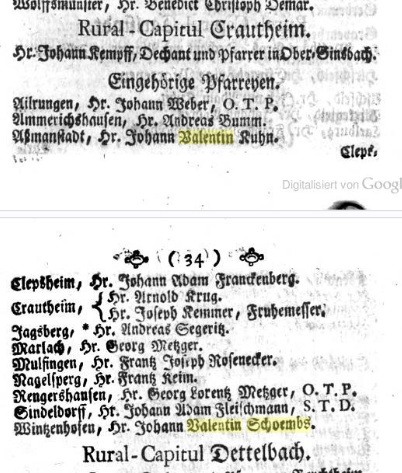 |
Extract from the
Court and State Calendar 1760 |
- A further interesting discovery was found in "Hof-Stands-und Staatskalender 1760" of Fürstliches Hofstiffts Würtzburg und Hertzogthum Francken. (Princely Court Abbey Würtzburg and Duchy Franconia). There was listed a "Johann Valentin Schoembs" from Witzenhofen (today Winzenhofen in Baden-Wuerttemberg). The emergence of a family member in this region and time was a surprise
Johann Valentin Schoembs, born in 1718 in Undenheim, was a son of Johann Philipp Schömbs. He became a priest and emerged in 1756 at Herrnsheim, the later residence of his brother Andreas as his groomsman as well as godfather of Andreas' son Valentin. One can clearly see in the following excerpt of the Churchbook of Herrnsheim Wintzenhofen the place of origin of Johann Valentin Schömbs. Obviously Johann Valentin Schömbs was only for a short time in this place, in otherwords in context of his education or his occupation as a priest, before he returned to his homeland Rhine-Hesse as a cleric.
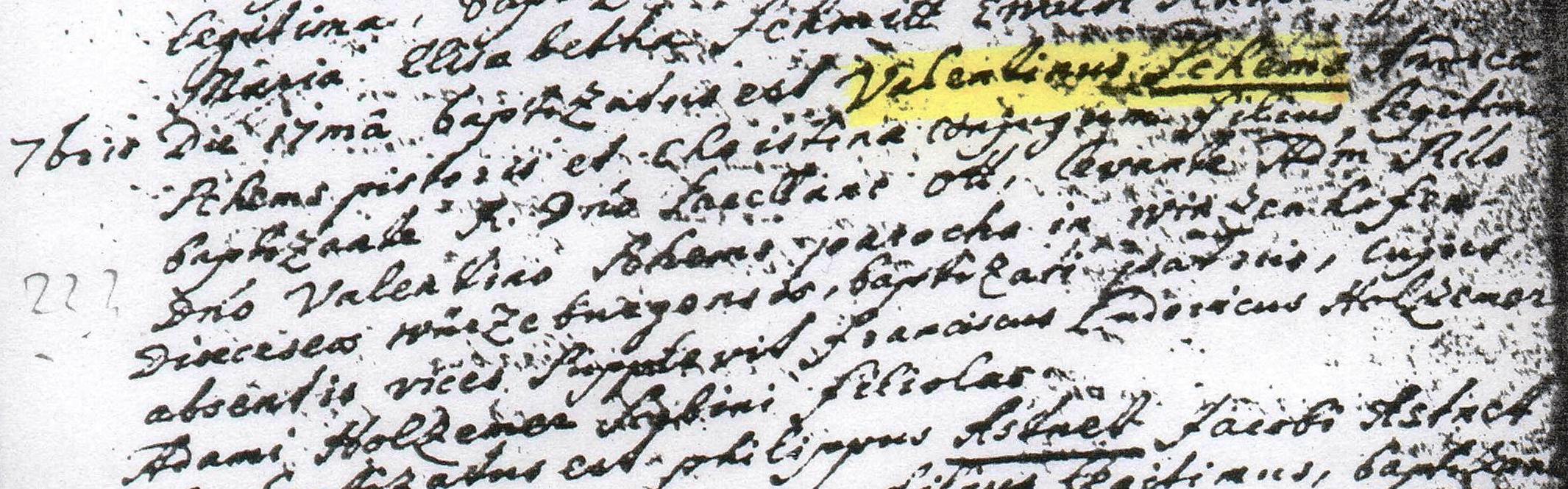 |
Birth Record for Johann Valentin Schembs (Catholic ChurchbookHerrnsheim 1759)
|
- Independently there are many families with names like Schimpf and Schempp in Baden Wuerttemberg. Zacharias Schömbs'name was spelled "Schimpf" too in the first document. It might be Zacharias came from this region. More research is warranted. "Schimpf" is also in the General Index of Coat of Arms (No. 4434 and 4435) in relation with the city of Tübingen.
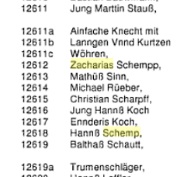 |
| Schempp and List of Names 1521-1603 |
- Another interesting finding is in a list of "Württhembergische Musterungsliste des Amtes Balingen (list for Army physical of the Department of Balingen, Wuerttemberg) 1521-1603. A "Zacharias Schempp" is listed, similar to our Zacharias. A relation between the Schempp family and ours cannot be ruled out. But our first and eldest known ancestor (Zacharias) was born much later.
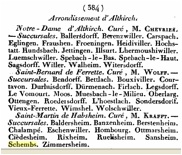
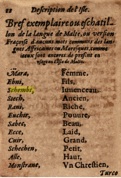
"Schemes" as family name also was found in other regions (e.g. 1704, 1733, 1747 in the Alsatian "Waldhambach" and 1774, 1876 in "Hannover"). It is told, that one can order a kind of sparkling wine in a restaurant named "Schems". Looking up the directories of Alsace did not confirm any "Schembs" in this regio. In medieval times the name "Schimpf" existed in Alsace, so a connection to our family is conceivable.
 |
 |
Source: Almanac
"La France ecclésiastique: almanach du clergé" |
- The discovery of "Schembs" as an old town name of Alsace could be a hint of the Alsace region as the place of origin. This might be also a starting point for further investigations. In the Almanac image to the left, in the area of Upper Alsace nearby Mühlhausen obviously existed indeed a village "Schembs" in former times.
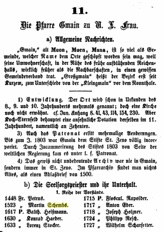
Another mysterious clue is the entry of "Martin Schembs" in "Historisch-Statistischen Handbuch der Erzdiözese Salzburg, Band 1,1862" (a statistical compendium of archdioces of Salzburg from 1862). With the reference to the year 1523 a pastor is noted as "Martin Schembs" in the parish of Gmain. Here, too, a relation to our ancestors is possible. Even the spelling "Schembs" at this time is difficult to imagine, especially if we think about the spelling "Schempp e.g." as the assumption in the first place.
 |
| Extract from the Statistical History Handbook, Archdiocese of Salzburg Band 1, 1862 |
- Another conjecture leads to Worms and a record from 1691 about Paul Schemb. Schembs was godfather at the Protestant christening of Paul Klotz at Lampertheim. The father of the child was Johann Peter Clotz from Worms, the mother was Anna Salome Beyer from Lampertheim.
A second clue needing to be verified concerns Worms-Leiselheim, where Johannes Schembs was born on 19.01.1741. He died on 21.01.1811 in Herrnsheim. Johann Schembs was married to Barbara Oemich from Herrnsheim. His father was Josef Schembs, married to Anna Barbara Herz. Taking account of Johannes' year of birth his father must have been born between 1720 and 1730. At this point we cannot connect him to either Herrnsheim or Undenheim.
- I recall when I was growing up, but also interesting from a family history perspective, there were two prominent reminders of past members of the family in their former towns. They are street names that carry the names "Schömbs" today.
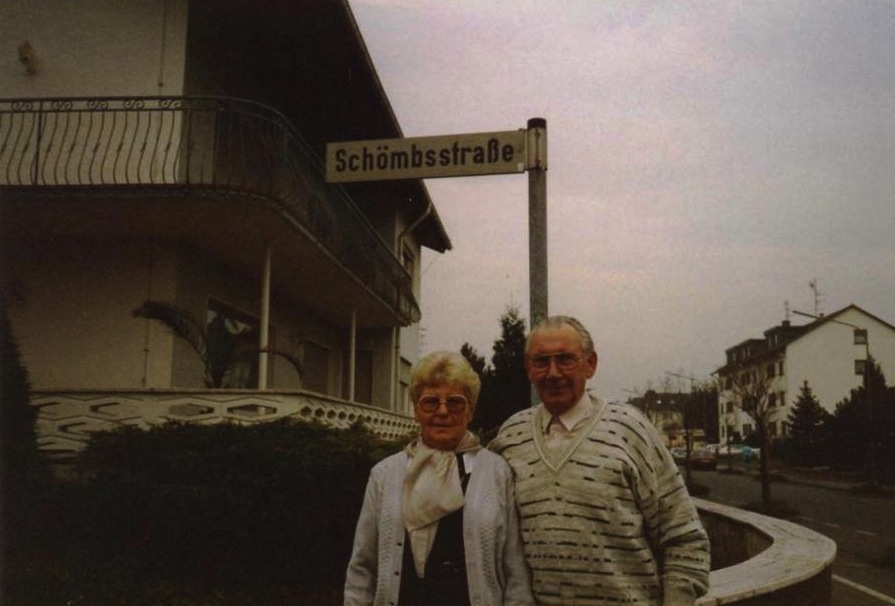 |
Franz and Rosel Schembs, Laubenheim
on the Schömbs-Straße in Urberach (1988) |
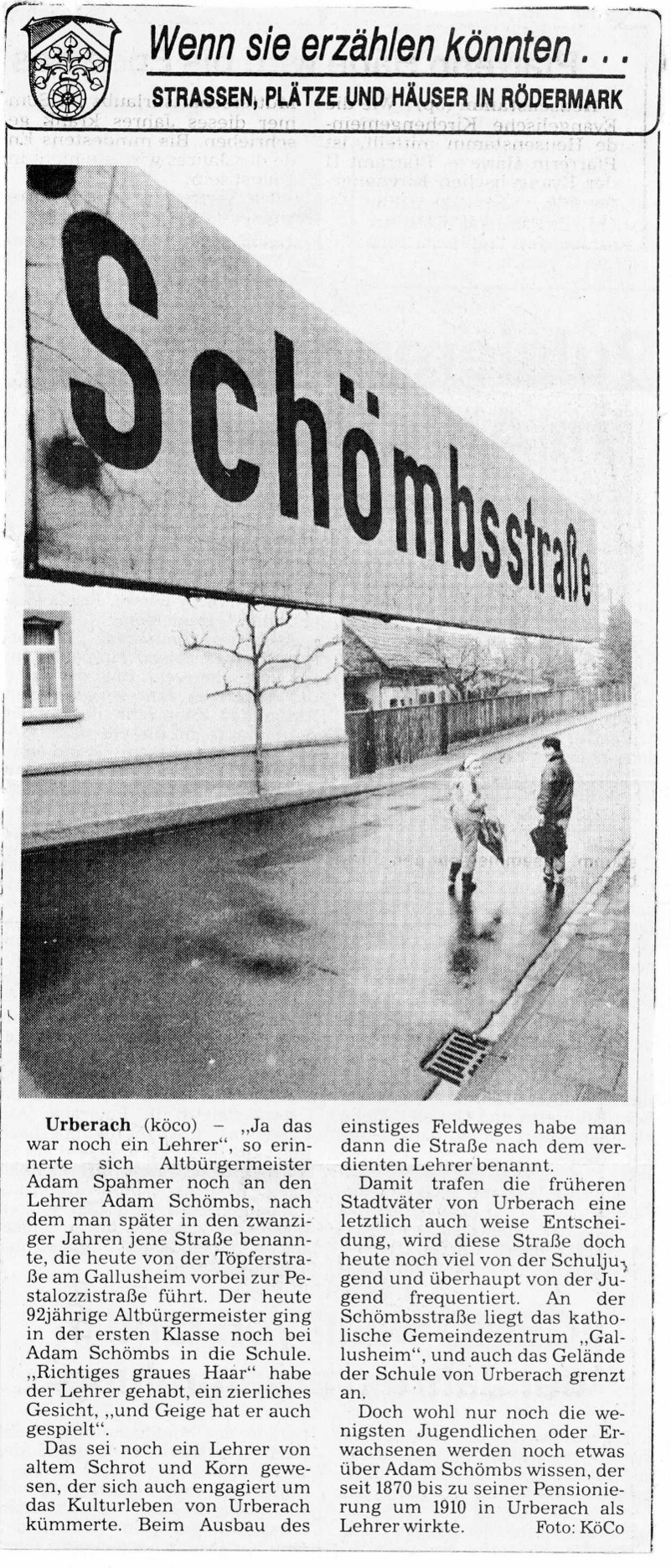
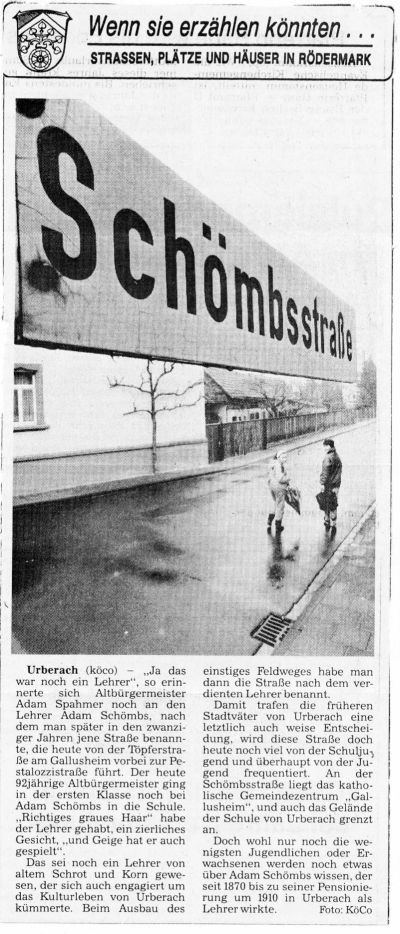
- So there is in Hessian Urberach (district of Rödermark in the district of Offenbach) a Schömbsstraße (Schömbs Street). It is named for the Headmaster Martin Schömbs (1819-1901) and his son Adam Schömbs (1852-1929). See also the following newspaper article as well as the conferral document (see Chapter about the "Undenheimer Schömbs" and Adam Schömbs -- 2.3.6./8). These two men were prominent in education in the towns of Urberach and Hahnheim.
 |
 |
 |
Article in the Local Paper about the Schömbs-Straße in Urberach
Click to enlarge |
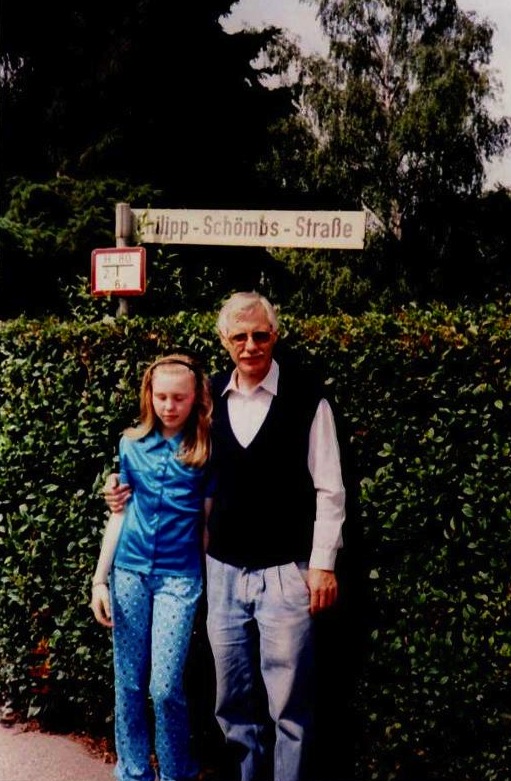
Reinhold Schembs with Daughter Christine (1997) on der Philipp-Schömbs-Straße
in Hahnheim
|
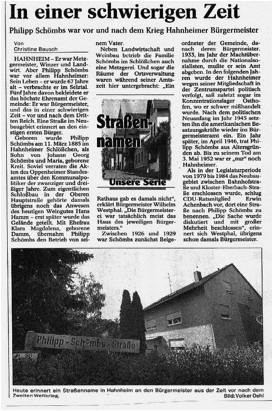
Article in the Allgemeinen Zeitung Mainz " Landskrone"
about Philipp Schömbs (1999) |
- A Schömbsstraße also exists in Hahnheim/Rheinhessen. The street is named for Philipp Schömbs, farmer and master-butcher. He was for many years the Bürgermeister (mayor) of Hahnheim. His contributions were recognized in a 22 July 1999 article in Zeitung Landskrone (see above).
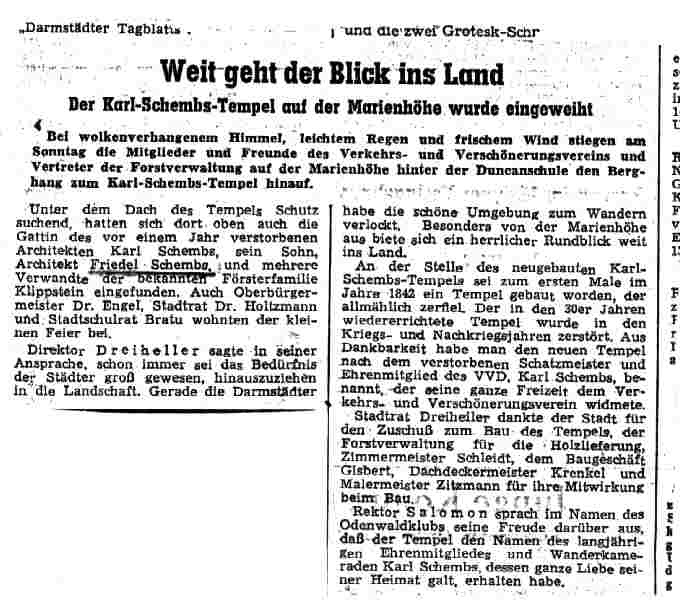
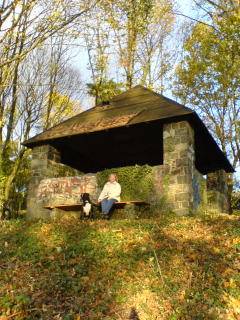
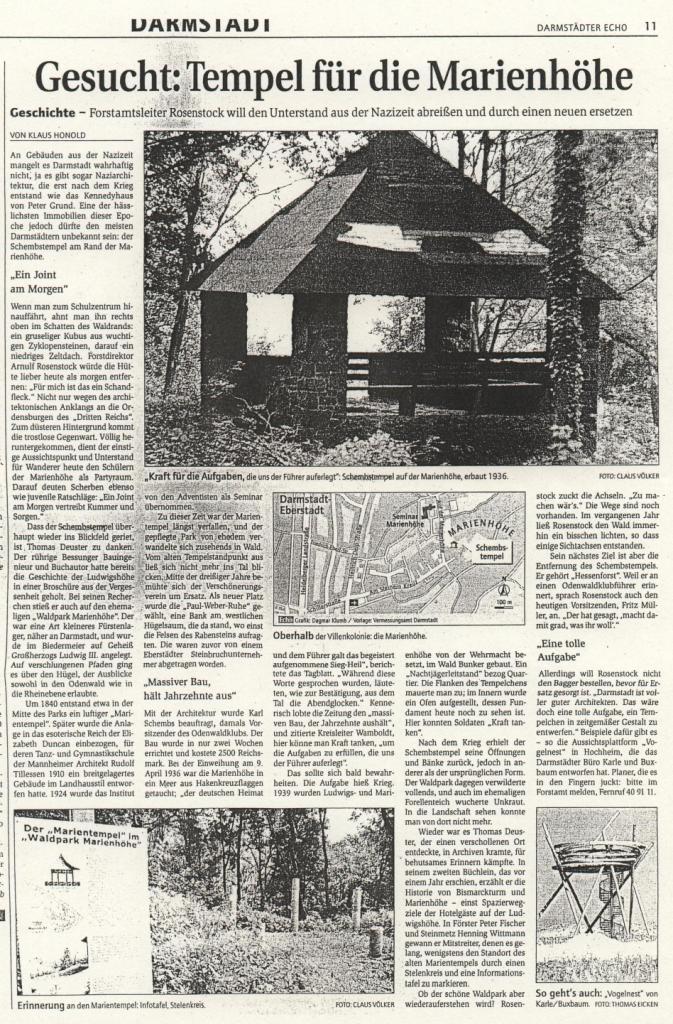
Another interesting place is located in Darmstadt on the Mathildenhöhe – a very popular spot with a great view into the surrounding region. There in 1952 a nature temple was erected and named in memory of the deserving Darmstadt architect Karl Schembs. See the article and photograph below.
 |
 |
 |
The "Darmstädter Tagblatt"
Click to enlarge |
Karl Schembs-Tempel on the Mathildenhöhe in Darmstadt |
"Darmstädter Echo"
Click to enlarge |
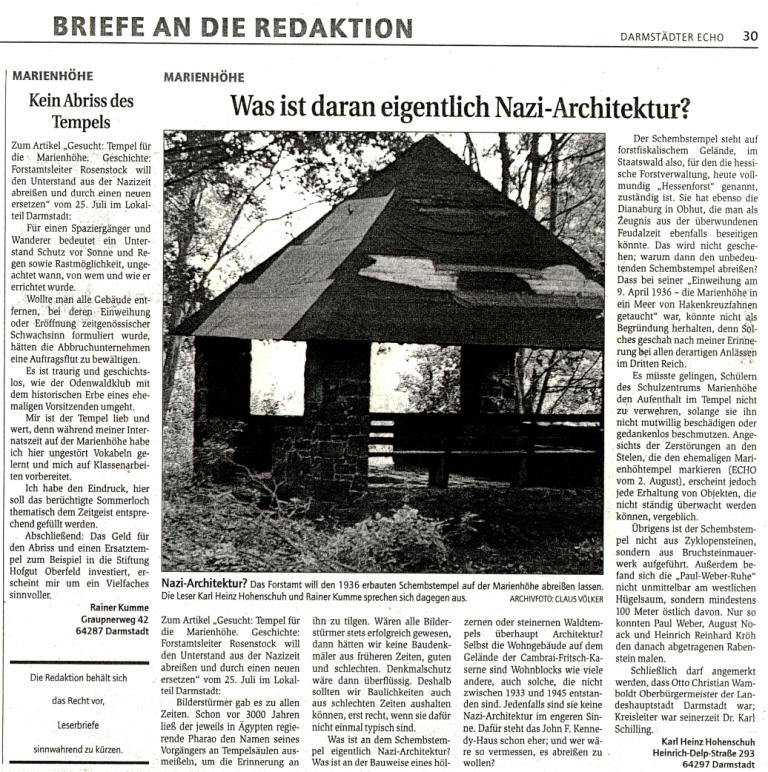
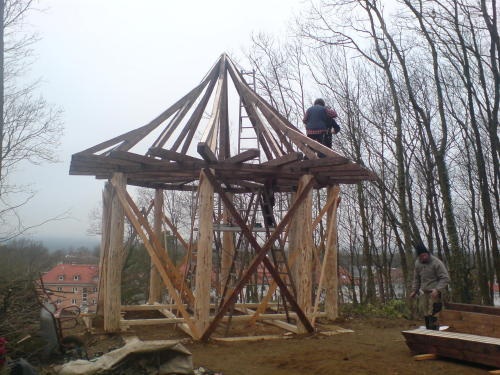
- Consideration began in Darmstadt in 2007 to demolish the "Schembs-Tempel", which was erected in 1936. Notice the article from July or August 2007 published in "Darmstädter Echo". The forestry commission office responsible for this area decided in 2008 after due consideration to demolish the "Schembs-Tempel". The demolition was carried out. But then in 2008 a "New Marientempel" was erected at this spot on the basis of the original plans. The inauguration ceremony was a forest festival in May 2009.
 |
 |
Click to enlarge |
Construction of the "New Marientempels" in Dezember 2008
Click to enlarge |
- An exciting moment in 2011 was the discovery of the gravestone (fragment) of Hermann Schömbs born in 1666, the first village mayor at Undenheim.
This old stone is testimony our family originates from 1718. It was open to public view a short time ago, even though it had been discovered in 1954 in the basement of the school of Undenheim. Today the gravestone is treasured at the "Kulturscheune" (culture barn), the museum of Undenheim, together with other old monuments of the community.
Documentation of the exhibits will be done by Walter Schwamb from Köngernheim in tradition of the local historian Dr. Curschmann from Undenheim.
Schwamb also finished the listing of Undenheim families from the Catholik Churchbook commenced by Dr. Curschmann. It will be published soon.
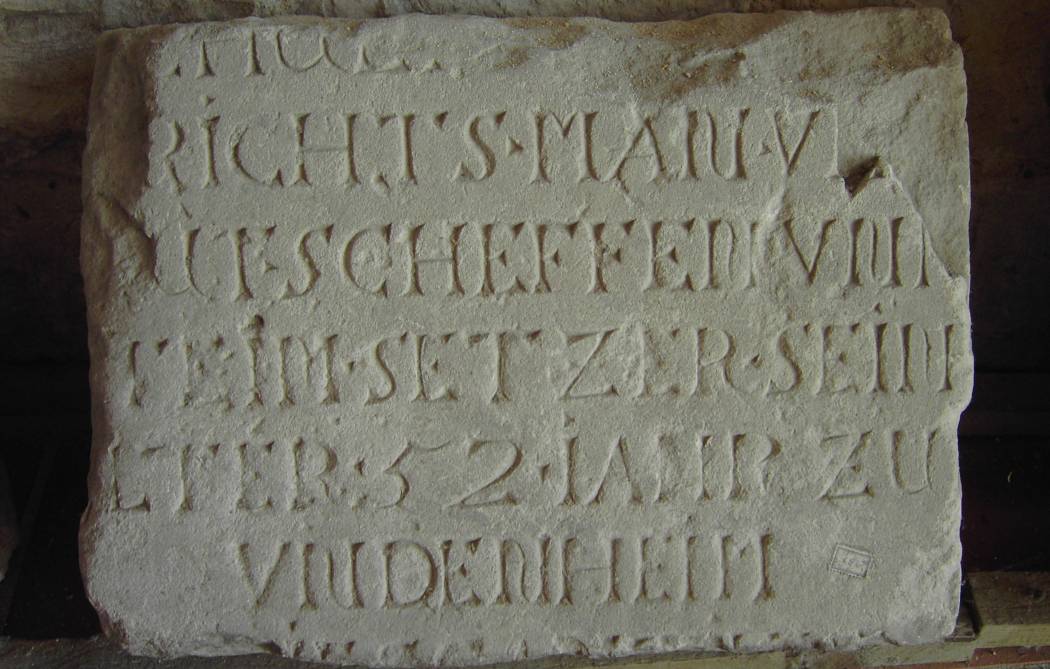 |
Gravestone of Hermann Schömbs (1666-1718)
Click to enlarge |
- The inscription on the gravestone:
- S)CHULT(heiss
Ge)RICHTSM:MAN.VN(d
BL)UT.SchEFFEN, VUND
S)TEIN.SETZER.SEIN
A)LTER. 52 JAHR. ZU
VNDENHEIM
- or,
-
Village mayor
marshal
juryman
and stone setter
age 52 year
to Undenheim
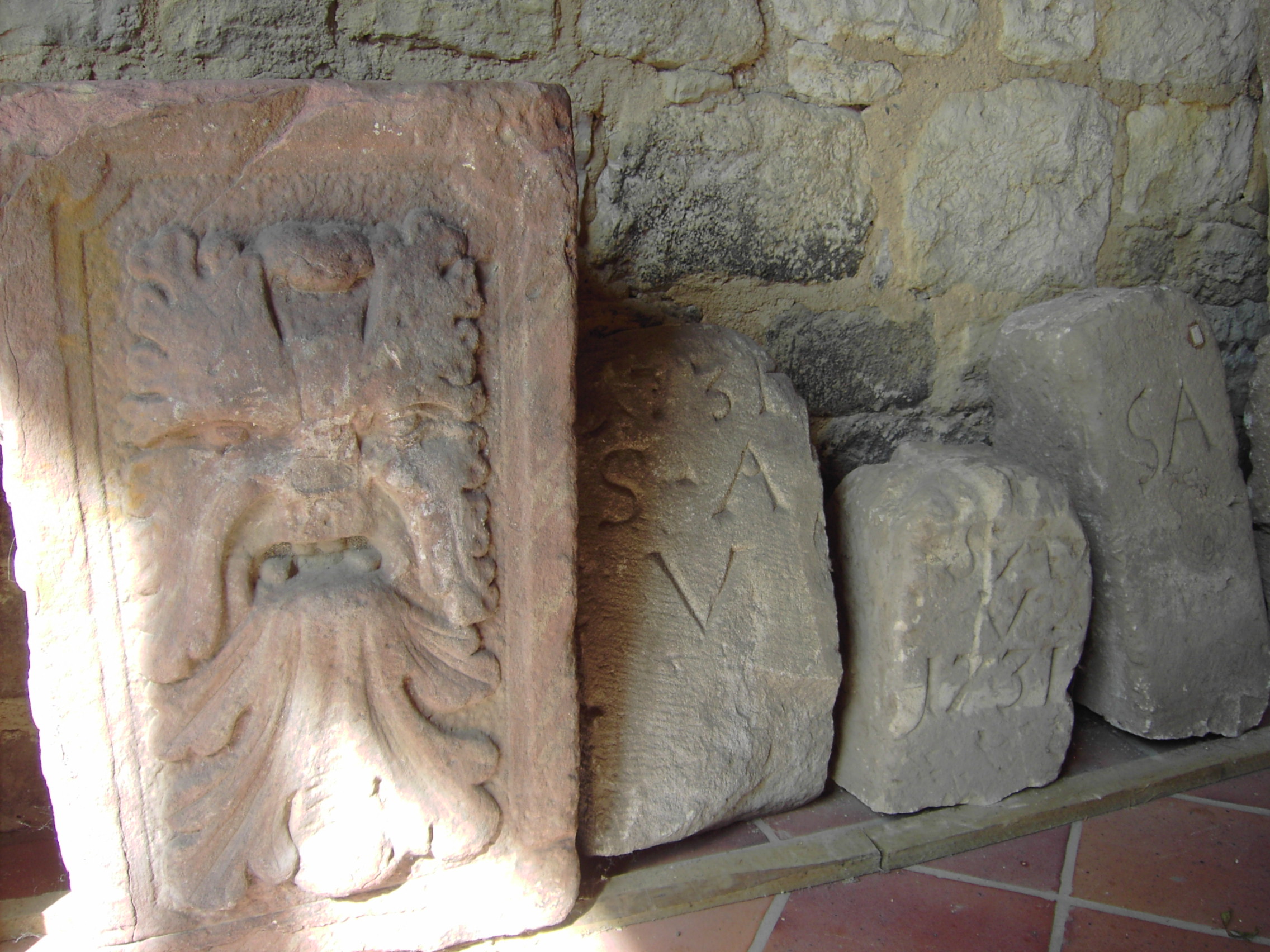 |
Other Exhibits from the local Museum
(Fratzenstein, Grenzsteine, St. Alban)
Click to enlarge |
- Outside of Europe too, far way in India and Latin America, family members have left their mark. There is a school for Santal children in West Bengal/India named after Dr. Rolf Schoembs, an astrophysicist (look at chapter B, 2.1.1/2). The school is part of a project of development aid of Martin Kämpchen, a writer. Dr. Rolf Schoembs left money to Kämpchen to support his efforts to teach the children their native language Santali and later Bengali. As a reward and remembrance the school was named after him.
In Latin America (Guatemala) one can trace the trails of Dr. Jaques Schoembs (look at chapter B, 2.3.6/6), a teacher. Starting in 1901 he lived several years as a private teacher in Guatemala and published a book on the Mayan grammar: "Aztec literary language, grammar with phonetics", which has survived until today.
Drawed by the keyword "Schöms-Währung" by the search for traces I discovered a website about the town Schömberg/Black Forest. It was a report about a summer camp for children, where they founded their own village named "Schömsala". They published a newspaper Schömsala, created a Schömsala-song and had their own currency. 15 Schöms one earns for one hour to work, reduced by five Schöms as a tax to maintain the community facilities. So the name of our ancestors had a very special using and meaning in this fictional town.
During the WW II. in Poland existed a real village named "Schems". In 1939 the Polish rural community Podzamek Golubski together with the boroughs Galczewo, Kujawa, Lisewo, Nowawies, Ostrowite, Podzamek Golubski, Skepsk and Sokoligora became a part of the German Reich. The villages were re-named. "Skepsk" changed at first to "Skemsk" and later into "Schems". After the implementation of the German Municipal Code in the eastern territories the village belonged to the district Schloss Golau.
-
- FOOTNOTES:
- [1] Laubenheimer resident list from the year 1551 "Die Einwohner des Kurmainzischen Amtes Olm 1551-1554
- [2] population register for Laubenheim, 1670, Laubenheimer Ortschronik, S. 85
- [3] from 1801 the left-bank (west) of the Rhein had fallen to France. Napoleon introduced a "Civil Code". One consequence was the separation of church and state. Compulsory civil marriage was introduced. Thus civilian documents exist from this date forward.
- [4] for example see Chapter D "The Laubenheimer Schembs", 2.3 death record for Johann Schembs from the year 1805
- [5] see Chapter D "The Laubenheimer Schembs", Zff. 2.3/2.4 marriage records for Johann and Andreas Schembs from the year 1803
- [6] like Footnote 4
- [7] see Chapter D "The Laubenheimer Schembs", Zff. 2.2 death record of Catharina Schembs from the year 1836
- [8] Catholic Churchbook Undenheim, 1769, 1772, 1774
- [9] Catholic Churchbook Undenheim, 1744
- [10] Dieter Curschmann, Geschichte von Schule und Kirche in Undenheim - Festschrift -, with a list of residents in 1695 with mention of the Schömbs family
- [11] see Chapter B "The Undenheimer Schömbs, Zff.1 Minute Book of St. Alban, 1691, lease award to Zacharias Schimpfs
- [12] Stetten vor dem Donnersberg 835-1985
- [13] Roots Projekt "Study of all the Schembs Immigrants to America, their Lives, and their Descendants" by Jim Schembs,USA, -attached hereto-
-
|
|
|