- Franz Schömbs of Mexico City, Mexico
CLICK to trace the ancestors of Franz Schömbs If it does not take you to Franz, Return to this page and CLICK again - The Story of the Oppenheimer Schömbs Emigrants
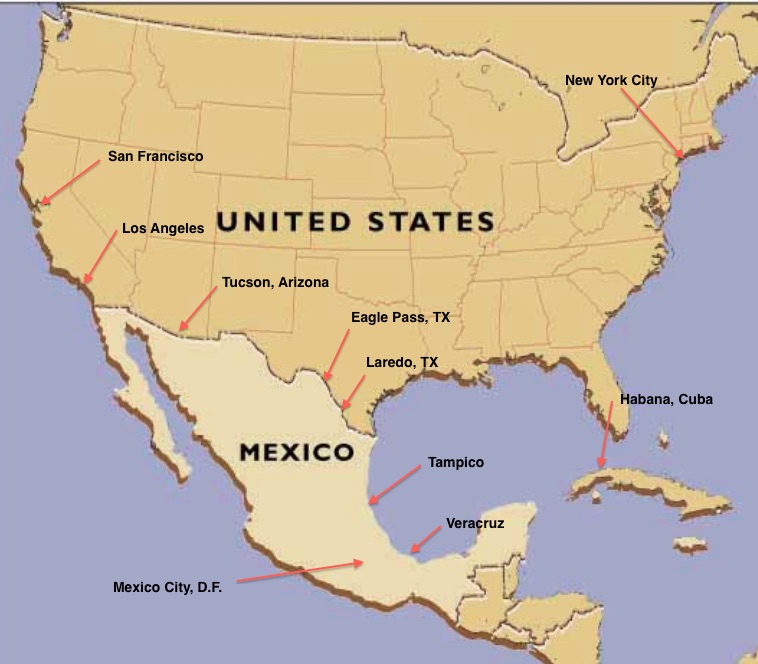
Mexico and the United States
Click the image to enlarge- Bernhard (*1862) and Katharina Bell Schömbs, residents of Oppenheim at the end of the 19th Century had five children, four sons and a daughter. Three of the children emigrated to the United States or Mexico. The stories are best read together to see how their lives intertwine: Paul (*1892), emigrant to the United States; Franz (*1895), emigrant to Mexico; and their sister Franziska (*1899), emigrant to Mexico.
The map on the right, when enlarged, can be helpful in following the stories of the three siblings. - The Story of Franz Schömbs (*1897, +1975)
- We learned of Franz Schömbs (*1895 Oppenheim) in Mexico when the record of his 1924 marriage in Tampico was discovered. It then raises the question, which of the siblings was the first to go to Mexico, and when. We know Franziska, their sister, emigrated from Germany to Mexico in 1923 from the passenger list of the ship Toledo. Their older brother Paul emigrated to the United States in 1911 and soon settled south of Tucson, Arizona near the Mexican border.
In 1921 Paul Schömbs became a U.S. citizen and immediately submitted his U.S. passport application. In it he stated it was his intention to go to the City of Tampico, Mexico. Tampico, as can be seen on the map is on the Gulf, north of Mexico City. Mexico had just ended a decade of rebellion and civil war. Wikipedia's story of the Revolution is interesting. While the hostilities were going on, discoveries of significant oil reserves were also taking place. In 1911 the first petroleum exports from Mexico occurred. And from the city of Tampico on the Gulf coast. From 1917 the volume of exports grew rapidly and reached historic high levels during the period of 1921-1925. Again, Wikipedia is helpful.
Paul's Resident Alien document indicates Franz was in the German military during the First World War, which ended in 1918. The Treaty of Versailles was signed in 1919. Most likely Paul was the first to go to Mexico in 1921 to seek opportunities relating to the oil boom. Franz then followed, emigrating from Germany to Mexico in 1922 or 1923.
The members of the family wrote to each other somewhat frequently. Fortunately we have many of those letters received by Paul (*1892). Assuming we have most of the letters received by Paul, Franz was by far the most prolific writer. In the Timeline are 27 letters from Franz (a few were written later in his life by his wife Rose); 6 letters by Siska; and 5, 3 and 2 by Bernhard, Ludwig and Katharina respectively.
From these letters we get much insight into the lives they led, whether they be in Germany, Mexico or the United States. The letters by all the siblings are included in the Timeline of Paul Schömbs Bell. To read those written by Franz, which details much of the life of Franz and his wife Rosa, go the Timeline. In column 3 ("Event") one can see which are the Franz letters. A synopsis (in English) of each letter is bulleted in the "Comment" column. To read the original letter, click on the PDF Link in the right-most column. With the exception of Franz's letters beginning in late 1939, they are all in German.
The references to the letters in the Timeline are included in parentheses below. - The Marriage to Rosa Bauer
- Franz and Rosa Bauer (*1897 Munich) were married on 31 January 1924 in the city of Tampico in the state of Tamaulipas. Tampico is a major port city on the Gulf of Mexico. According to the marriage record Rosa was 27 years old, the daughter of Josef and Emilia Grau Bauer.
- Tampico, Mexico
- Franz and Rosa lived in Tampico for the first years they were in Mexico. We know this from the return addresses of Franz's letters. They never enjoyed Tampico, for they immediately were talking about moving to Florida in the U.S. (22.10.24). But Franz must have had a good job in Tampico. He frequently sent money to his brothers in Germany, whose businesses were struggling after World War I. His brother Bernhard in Germany wondered if Franz would have to sell his property in Munich in order to buy in Florida (23.11.24).
Their sister Franziska "Siska" was married in Mexico City in September 1924 to an Austrian emigrant Erich Dietz. Almost immediately the relationship between Franz and Erich turned bad. "Ludwig understands that Franz had a disagreement with Siska's husband Erich." Bernhard says he hopes that they can solve their problem. (23.11.24)
Later in the year Franz tells Paul that he has been promoted. He was working for Compania Transcontinental de Petroleo, S.A., which apparently was owned by Americans. Franz commented that he expected to receive a raise of $50 with his promotion but that decision was to be made by management at 26 Broadway in New York City (23.12.24). Rose asked Paul, who happened to be taking flying lessons in Chicago at the time, if he would please buy a new blue formal suit for Franz. "You must know the correct size for Franz. Just the same as you except a little smaller in the chest." (23.12.24) - In 1925 Franz encouraged Paul to return to Tampico from Chicago and, rather than starting a flying business, to consider coming to work for the company where Franz worked. "There is a new superintendant (Wiedman) locally and things have gotten better." Paul had perhaps worked there previously, as he seemed to know the people at Franz's company. (10.01.25). But then later in the year Franz said "Tampico is going to the dogs. All companies are cutting employees's pay." In the same letter Franz told Paul that Ludwig's riding school business was having hard times and he might have to give it up. This was a surprise to Franz. Franz had not heard from Siska, their sister (their relationship was strained). (24.11.25). Franz told Paul that his tennis game was getting better. And said he has been thinking of moving to Australia, although that was partly out of boredom. He wrote a letter to Ludwig a week earlier but did not know if Ludwig would respond. Apparently Ludwig had asked Franz if he could loan him money and Franz had refused (01.26). Franz and Rosi were still living in Tampico at the time.
- A few months later Franz crossed from Mexico into the United States through the border city of Laredo, Texas. The date was 2 July 1926. The record is very brief. We have no other information regarding the trip to the U.S. but it was likely for business.
- Companies and Cities
- In 1928 Franz reported that he "quit the trouser company, been working at a new job at Mexican Oilfields (Seabrooks) for a month". (3.07.28) These companies were most likely in Tampico. In a later letter Franz remarks that they had lived in Tampico for seven years. (6.11.30) This would be right -- from 1922 until 1929.
In 1929 Franz and Rosi made a lengthy trip to Germany. Franz said that "he had spent nine months traveling and it took a lot of money." (30.05.30) Upon their return to Mexico Franz and Rosi moved to Mexico City. Over the next ten years Franz was involved in several businesses, some as an owner or co-owner.
Franz's first employment in Mexico City was with a small company by the name of Tacones, a company producing heels for women's shoes. There were two partners in the business, a Mexican and a Swiss. He was very optimistic about the prospects for the company and was soon given the opportunity to invest. "He planned to stay in Mexico City with Tacones for the near future. He also wanted to find a new girlfriend for Paul, after the failure of Paul's marriage a couple of years earlier. Rosi could find a nice German girl while she was still in Europe." (30.05.30)
By November of the year Franz comments that he bought a 20% interest in Tacones for 3000 Pesos, "a lot of money" but he believes it will work out well. He and Rose have moved into an apartment. He borrowed furniture from his sister Siska until he and Rosi can buy their own. (6.11.30) But then a few months later he wrote "there is a lot of trouble between the three partners." (8.02.31) Then five months later "he hopes his investment is not lost" (13.07.31) By the end of the year Franz and Rosi moved again to be closer to the business. (22.12.31) And Franz bought a motorcycle to commute to work. (14.03.32) And five months after that they moved again. (25.08.32)
At the beginning of 1933 Franz said he "lost all his money invested in Tacones. The egg business was more successful, he was able to get back everything he had invested." (14.01.33) It is not clear whether he means the money he had invested in "the egg business", or had invested in Tacones. Probably the former. Regardless, he is now involved with a new factory in the (rubber) vulcanization business. In two months the owner is leaving for a year in Germany and Franz will manage the business in his absense. (14.01.33)
A few years later Franz repeats that he wishes they could go back to Germany permanently. And also have children. (20.12.37) Rosi wants to go back to Germany forever. (25.10.38) - Franz, the "Family Banker"
- From early in his time in Mexico Franz's siblings periodically looked to him for financial support. There are repeated references in his letters to requests for help. During the 1920's he appeared to be doing well enough financially to respond. In early 1924 Franz provided Bernhard, one of his brothers in Germany, with money. "Bernhard's business continues to not go well and the $1500 he sent Bernhard has been mostly spent." (23.12.24)
The following year Ludwig, his other brother in Germany, apparently also asked Franz for help: Franz said "he has not heard from Ludwig since he refused to lend them money". (23.12.24) Then a year later "Franz had always thought Ludwig's business (riding school) went well but now he learns that Ludwig has debts of about 1500 Mark. Franz decided to give Ludwig the money because Ludwig brought up the issue. He is proud of the business and spoke from his heart. Franz fears, if Ludwig is under pressure, he will go to a Jew who will charge him very high rates for a loan. He fears Ludwig might have to give up his riding school." (24.11.1925)
But by 1930 the Great Depression was weighing upon the economies of all the countries around the world. Business in Mexico became very bad. And with his investment in Tacones, in which he lost his money, Franz's financial position came under stress. This is commented upon in several of his letters to Paul: "Assures Paul that he would like to assist him financially but, at the moment, the best intentions in the world won't help. What he had, all went down." (6.11.30) He thinks he should be better able in a year. Three months later, "Regrets not being able to take out a loan for Paul, because there is borrowed money in the factory from the bank that has to be paid on a certain date. Complains that there are terrible bad times with unemployment and misery wherever you look. Presumes that it is no different in the States, as to read in the newspapers. " (8.02.31) And in the middle of the year "Would like to help Paul, but he doesn't know how he can". He also reported to Paul that Siska and Erich cannot help either. (17.09.31)
In early 1932 Siska wrote Paul: "I'm glad that I was able to pay Franz, I had to endure a lot of bad moods until I paid him back. I was able to pay my share for Mother's funeral, which was also carried by Franz' money alone. If it works out again, he should also get the part that he laid out for me for mother's last year of life, so that sister-in-law Rosl doesn't have to keep talking about it." (29.03.1932) - Return Visit to Germany
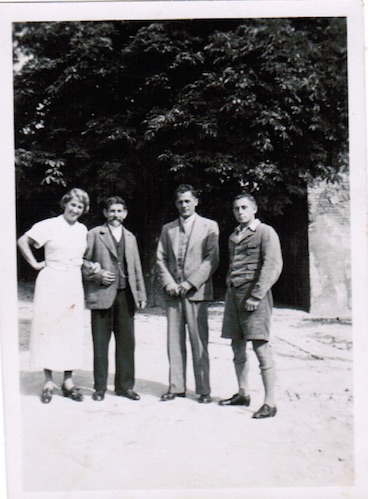
Rosa, Philipp Unkel, Franz and the son of Anna Ruf, 1937 Oppenheim.
Click the image to enlarge- Franz and Rosi returned again to Germany in late 1936 for a visit. In a letter (7.05.36) they commented about their upcoming trip and that they had been in Germany six years earlier, i.e. 1929/30. Apparently Rosa's stay in Germany was longer than that of Franz, for on 14 March 1937 she returned alone aboard the ship Saar, which disembarked from Bremen, Germany with the destination of Mexico. She traveled in "cabin" class, as did the other five passengers aboard. Her nationality is given as Mexican and her previous Place of Residence is München (Munich), Germany. On the ship's passenger list Rosa indicates her trip ends in Mexico City.
They sent a photograph taken in Oppenheim with "Philipp Unkel and the son of Anna Ruf" written on the back. The photo (to the right) indicates "Philipp Unkel". However, it is probable this was actually Franz's Uncle Philipp (*1865).
- Move to Pachuca, Hidalgo
- By late 1937 Franz and Rose had moved to the city of Pachuca in the State of Hidalgo. Located about 100 Km (60 miles) northeast of Mexico City, Pachuca is at an elevation of 2,400 Meters (8,000 feet). It was a major mining area until the mid-20th Century. Franz was likely involved in the mining business. (20.12.37)
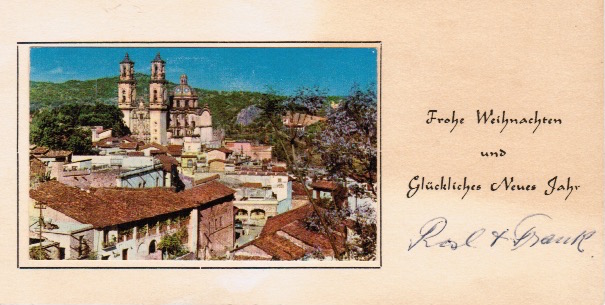
Weihnachtskarte (Christmas card) from Franz and Rosa to Paul, 1935
Location is probably Pachuca, Hidalgo
Click the image to enlarge- Franz began to apologize for not writing in English (so Irene and the kids could read his letters). He said Rosi would like to go back to Germany permanently, that he would stay a little longer and then follow her. "People here hate foreigners" (25.10.38). And a few months later "many Germans in Mexico are starting to return to Germany. Things are bad in Mexico. There is a manpower shortage in Germany. We are glad we still have our house in Munich (20.01.39)." (note: Germany was rebuilding their military and industry and soon to initiate World War II)
Nine months later Germany invaded Poland, the start hostilities which soon became World War II. Three months after that Franz writes that Rosi wanted to go to Germany in September. But could not. The ship did not sail because of "the war over there" (18.12.39). - Franz and Rosi Depart for Germany -- Forever?
Letter from Franz to Ludwig, 1942
Click the image to enlarge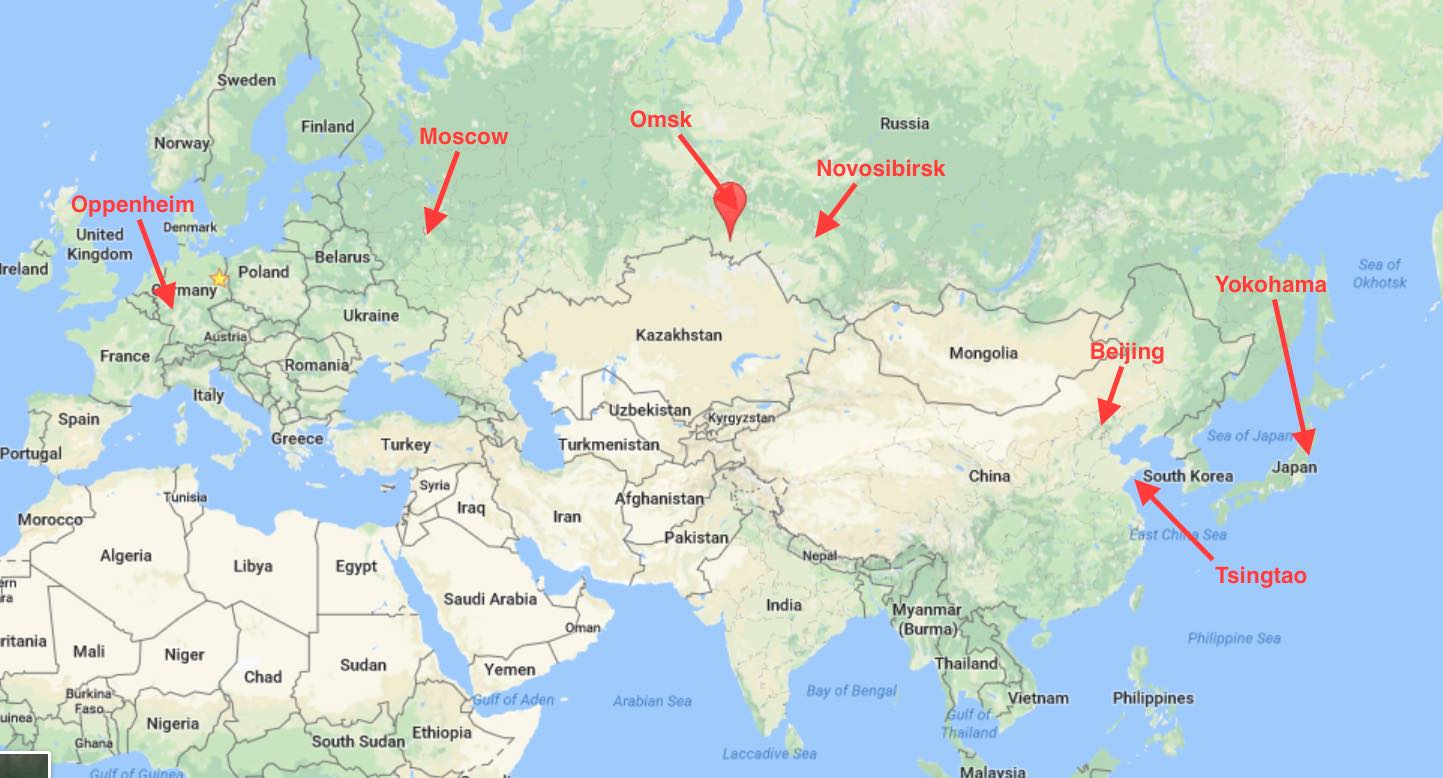
Map of Franz and Rosi's Journey
across Asia
Click the image to enlarge- By early 1941, after the war was raging in Europe and the United States was sending armaments to the French and British to oppose Germany and the Axis powers, Franz and Rosi made the final decision to return to Deutschland for good. On 27 April 1941 they boarded the Japanese freighter M.S. Heiyo Maru in Acapulco sailing for Tokyo with a stop in San Pedro (Los Angeles). From Tokyo they intended to go to China and through Manchuria into eastern Russia. A train ride across Russia would return them to Europe and Germany. Russia and Germany were not yet at war.
At this time (2017) we have only one letter documenting next 18 months. It is a fascinating letter from Franz to Ludwig in Germany. (27.04.41) In brief, they were traveling across Russia by train when Russia and Germany declared war upon one another. They were turned back at Omsk and returned to China. Click on the Letter to the right in order to read it. The letter was passed down to Bianca Ludwig Rochow, the granddaughter of Ludwig. To follow the letter a map, also to the right, is helpful. Hopefully in the coming months we will find another letter or two between 1942 and 1949 which will tell us how those seven years were for Franz and Rosi. At this time it appears that they spent them in Tsingtau, China.
We know today of Tsingtao from the beer of the same name, one of the city's largest industries. The Chinese name today of the city is Qingdao, a major port located across the Yellow Sea from Seoul, Korea. The history of the city is interesting. It came under German control in 1898 after the Chinese began improving its fortifications. During the 16 years the Germans governed, the city was modernized and infrastructure put in place. Because of its strategic importance, the city was put under the (German) Imperial Department of the Navy, rather than the Imperial Colonial Office. The German Navy based their Far East Fleet there. In 1914 the city came under the control of the Japanese, who were allied against Germany in World War I. In 1922 Tsingtau reverted to Chinese control.
Leading up to World War II the Japanese retook the city in 1938. After the end of World War II and the liberation of China from the Japanese, the U.S. Navy made it the headquarters of the Western Pacific Fleet in 1945. But the Chinese Civil War was raging. On 2 June 1949 Tsingtau was taken by the Red Army under the command of Mao Zedong.
At least in the latter part of his career Franz worked for a major international oil company. [1] It is possible that Franz began this employment while still in Tsingtau during the period from 1945 to 1949. If so, this could explain why they stayed in Tsingtau for four years after the war ended. - 1949 Franz and Rosa Return to Mexico from China
- In 1949 Franz arrived in San Francisco aboard the ship Fleetwood. It had sailed from Tsingtau on 1 February 1949, just four months before the city was taken by the Red Army under the command of Mao Zedong.
The passenger list has additional information. There were five passengers recorded. Franz was traveling under his Mexican passport #137981. He had three trunks and one hand package. Rosi, however, was not aboard. Perhaps she first went to Germany to visit before arriving back in Mexico. - Before Franz returned to Mexico he fulfilled his often stated commitment to visit Paul in Amado AZ. He was very interested in the mining and prospecting activities of Paul and his partners. Then again in 1957 he visited Paul with Rosa. And finally in 1971 with Rosi and Siska.
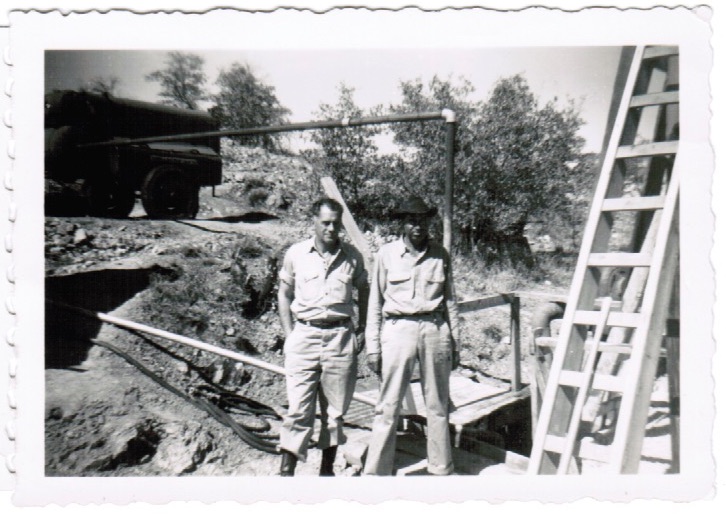
Frank and Joe Cañez inspecting prospecting site in Arizona
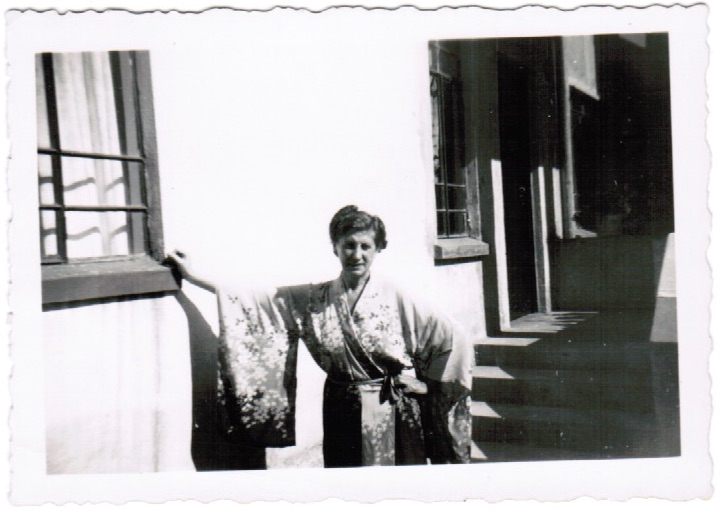
Click to enlargeRosa, circa 1950
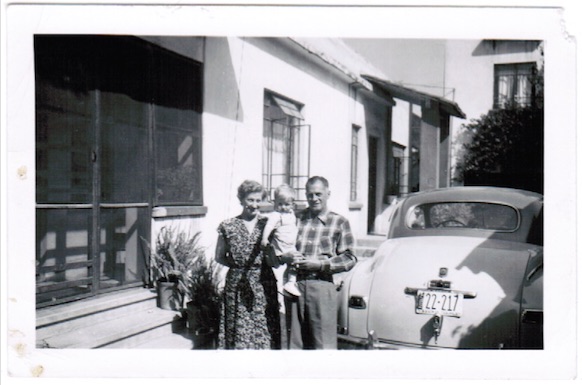
Click to enlargeRosa and Franz, circa 1952
Click to enlarge- Mexico City
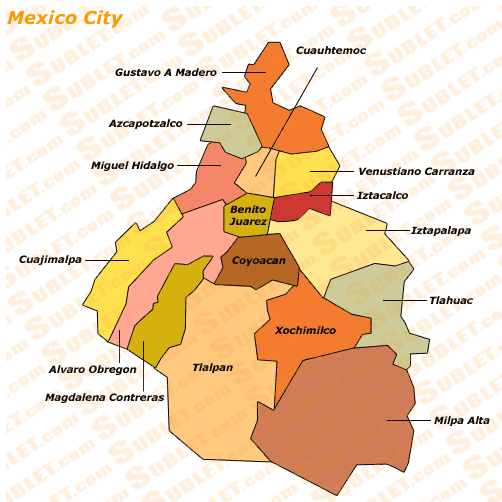
Mexico City Boroughs
Click to enlarge- In a letter from Siska to Paul from 1952 she commented that Franz and Rosa were living in her former home in Mexico City. "She had transferred it to him" (19.06.52). Ten years later Franz wrote "if they are able to sell their property they will move to Valle de Braio (spelling?) on the coast. It is less expensive living there. Americans are finding they can live on small pensions" (15.12.62). Following the 1968 Mexico City Olympics Franz wrote "he is glad the Olympics are over. They lived near the Olympic venues and the City was always crowded. Paul would not recognize Mexico City now." Franz also mentioned that he suffered from vertigo. He wanted to stop driving and not risk an accident (2.12.68).
By 1970 the letters were written by Rosi, Franz's wife. She reported that Franz was losing his sight and could no longer write. (13.03.70) And the following year that they had sold their home and moved into a home for the elderly. Franz had had a heart attack. (12.71) A few months later Franz, Rosi and Siska came to Arizona to visit Paul. (24.04.72) Irene, Paul's wife, had passed away in April 1970. Then a few months later Rosi said that Franz was going deaf. He also was having cognition problems. (25.07.72)
The next month Erika (Ludwig's daughter) and her husband Heinz came to Mexico City to meet and visit with Franz, Rosi and Siska. (8.11.1972) In 1974 Rosi wrote "Franz's mental problems are getting much worse. He is also having trouble talking. He can no longer make sentences. She cannot understand what he wants." (1974) - 1975 Franz Passes Away
- 1982 Rosa Passes Away
- In 1978 Rosi and Siska made their last trip to visit Paul. They were both widows.
Rosa died on 28 March 1982 at the age of 85. Her death certificate identifies her as a widow and resided at Aldama 24-Tepepan, Xochimilco D.F.
FOOTNOTES:
[1] Lee Bell Taylor (*1936)
[2] Lee Bell Taylor (*1936)
- Find an expert in Mexican research at the FHC
- Try to find additional Franz letters in Paul's files written from China or commenting about their time there.
1924 Marriage Ancestry.com
1941 Entry into the United States Ancestry.com