- The German Emigration
- Conditions in Germany Leading to the Emigration [1][2]
- The first group emigration of Germans to America was in 1683, when Mennonites from Krefeld emigrated to Philadelphia, founding Germantown in the northern part of the city. Those who came here during the colonial period settled mostly near what was then the frontier in New York, Maryland and Virginia, but especially in Pennsylvania, which had about half of the 225,000 Germans in America in 1776.
Germans along the middle Rhine River Valley, the area of most interest to a Schembs, had experienced centuries of social, religious and political unrest since the days of the Holy Roman Empire. There was not a country of Germany as we know it today, but rather a multitude of areas governed by their local dukes, barons or kings. Borders between these semi-autonomous regions shifted with the outcomes of wars and the passage of power through the generations.
Protestantism (mostly Lutheran, but also Calvinism with Anabaptism pockets in the south and west) became the dominant religion in many German areas in the first few decades after the Reformation. But the Counter-Reformation regained Catholic predominance in the Rhineland and other areas. The Peasants' War of 1524-25, which was directed against oppression by secular authorities and feudal lords, but inspired by Luther's revolt against the church, was squashed and left the peasants in a miserable and lethargic condition for several more centuries, especially in southern Germany.
The Thirty Years' War (1618-48) was the most devastating war ever fought on Germanic territory.[1] It started as a war to suppress Protestantism in Bohemia, a goal quickly achieved, but continued, with a few truces, as a war which at one time or another involved most of the countries in Europe, with Sweden, Denmark, and France helping the Protestant princes break the power of the Holy Roman Emperor. After 1635, when Catholic France, rather than the Protestant duchies, became the main opponent of the Emperor (the Hapsburg throne in Vienna), the war lost its religious significance. Historians estimate that one third or more of the German and Czech people died, many from famine. Many villages were destroyed, survivors were forced to flee, farmland was left uncultivated and commerce virtually ceased. As part of the postwar reconstruction, there was a major migration of people from areas which had been spared, more or less, to those which suffered the most. This took nearly a century.
With the rise of Napoleon in the late 18th Century, much of present day Germany and Poland came under French authority. Napoleon ruled many of the small independent German states much of the time from 1792 until 1815. There were many and frequent border changes, but the end result was the consolidation of over 300 existing principalities into 39 medium-sized ones. Napoleon also instituted civil registration of births, marriages and deaths.
French nationalism led to German counternationalism. This in turn led to the Wars of Liberation of 1813-15 and the liberal revolutions of 1830 and 1848 which sought a free and united Germany. After those events were suppressed, the German Empire was established under Otto von Bismarck's leadership as a result of the wars of 1864-71 against Denmark, Austria and France respectively.
Karl Marx issued the Communist Manifesto in 1848. It was at about this time that the Industrial Revolution in Germany, begun in the 1840's, started to accelerate. Over the next several decades, mass production eliminated the cottage industries on which many small farmers depended for the supplemental income needed to survive.
There was not large scale German emigration to the United States prior to about 1830, as the majority of the previous German emigration was to Eastern Europe. Beginning in 1845, there were three large waves of emigration to America up to 1895. During that period a total of about 5 million Germans came to America. The total number of Germans from 1820 until the present is approximately 7 million, representing the largest number of emigrants coming from any single country.
The first big wave of Germans crossing the Atlantic lasted from 1846 until 1858. It began as a result of famine produced by the crop failures of 1846 and 1847, which affected most of Europe. Those who fled as a result of the unsuccessful liberal revolts of 1848, which occurred in nearly all of the many Germanic states, added to the flow. This wave peaked in 1854.
The second wave, lasting about a decade, occurred immediately after the American Civil War. Three factors were important in generating this stream: free or cheap land in the United States as a result of the homesteading provisions of the Morrill Act of 1862; the economic conditions in Germany; and particularly the dislocations caused by the Industrial Revolution in Germany.
The third and largest wave occurred from 1879 to the early 1890's. Emigration from Germany reached an all-time peak in 1882. The closing of the American frontier in 1890 and the Panic (today we would say Depression) of 1893 halted this flow.
After 1840, the vast majority of immigrants landed at New York, being processed by the U.S. authorities first at Castle Garden and then, beginning in 1892, at Ellis Island. - Reasons for German Emigration
- A summary of the more important reasons for Germans to emigrate were: [1]
(1) Escape from economic hardship. Wars through the centuries devastated Germany. The Palatinate, including Rheinhessen, in particular suffered from being the frontline battleground between French and German peoples. (2) Religious freedom. Particularly important for some of the earliest emigrants, it remained significant for non-mainstream groups, like the Mennonites, Old Lutherans and dissident Catholics. (3) Abundant free or cheap farmland. The vast majority of immigrants to America came from rural villages, where there was insufficient farmland for all. German inheritance laws were of great importance in explaining emigration. Where one son inherited the entire farm, the others were effectively excluded from making a living in agriculture. Where the land was divided among all, the plots soon became too small for sustenance, which is why many peasants also practiced a trade. (4) Freedom from compulsory military service. The frequency of wars and the expectation of more led many to emigrate. This was particularly true of those who lived under the militaristic Prussian Empire, which already ruled most of northern Germany before 1871, and which thereafter had the dominant voice in the new German Empire. (5) Political freedom. This was especially important for the refugees from the unsuccessful liberal democratic revolutions of 1848. (6) Hope for economic betterment in other countries, particularly America. While most of the German immigrants sought farms, a significant number also settled in the cities, where the streets were reputedly "paved with gold." When they discovered how misleading this was, some returned to Germany, but the vast majority stayed, either because they found opportunity anyway or because they could not afford to return. (7) Personal and family reasons. Many came to join relatives or former neighbors who were already in America. - The Duchy of Hessen Darmstadt
- As will be seen in the following chapters, the Schembs emigrants came from a region of Germany known as Hessen Darmstadt. The origins of Hessen Darmstadt also go back to the Holy Roman Empire. Hessen Graffschaft, with Marburg being its principle city, encompassed the area of Hessen north and west of the Rhine River in the general area of present day Frankfurt (but excluding Frankfurt itself). In 1547 Hessen combined with Nassau on a conditional basis and annexed the area around the city of Darmstadt. In 1803, during the time of Napoleon, the western parts of Hessen were broken off. Twelve years later following Napoleon, Hessen Darmstadt assumed control over areas west of the Rhine including Mainz and Worms.
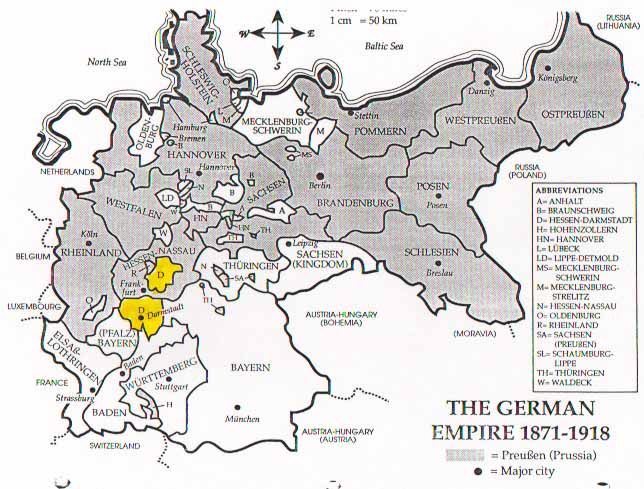
Above, The German Empire after the War of 1871 but prior to World War I, with Hessen Darmstadt shown as two separate territories --- highlighted in yellow in the left center and identified by "D". The city of Frankfurt am Main is between the two territories and a part of the state of Hessen-Nassau. 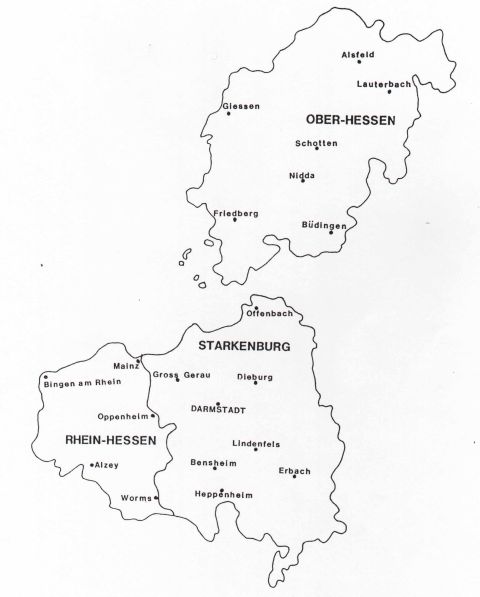
Right, the state of Hessen Darmstadt is shown in the latter part of the 19th Century. The Rhine River separated the regions of Starkenburg (to the east of the river) and Rhein-Hessen (to the west of the river). In the lower part of the map is the town of Worms; in the upper the town of Mainz. Both towns (and their outlying villages Herrnsheim and Laubenheim, respectively) are prominent in the history of the history of the Schömbs family! - The Schömbs in Hessen Darmstadt
- This section as it was originally written in the 1995 edition of The Schembs in America read as follows:
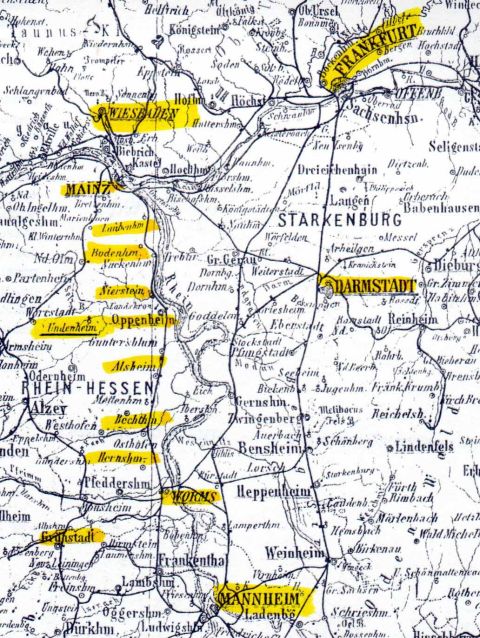
The Rhine River Valley from Mannheim to Wiesbaden - 19th Century towns - "Based upon the research to date, the Schembs family has its origins in the eastern part of Rheinhessen, along the Rhine River from the towns of Worms to Mainz. Later migrations of the family reached Darmstadt, Wiesbaden, and Cologne. Even today, there are very few Schembs in Germany who live outside this original area.
The map below shows the area from Worms to Mainz. Of the more than 200 pre-20th Century records of Schembs events (christening, marriages, etc. included in Appendix K), more than 90% are concentrated in this region. Towns with records of Schembs events are underlined. Major cities in the area, but without records of Schembs events, are shown in boxes for reference only. (Actually Darmstadt has records of Schembs events, but not until the late 1800's. The Darmstadt Schembs had emigrated from Laubenheim/Mainz.) The Rhine River flows from Mannheim to Worms, Mainz and Wiesbaden on its way to the North Sea.
As some of the names are abbreviated or otherwise difficult to read, they are from south to north: Mannheim; Grünstadt; Worms; Herrnsheim; Bechtheim; Alsheim; Oppenheim; Nierstein; Bodenheim; Laubenheim; Mainz and Weisbaden. Frankfurt and the city of Darmstadt are farther to the east." - At the same time I was publishing the book The Schembs in America in 1995, I was receiving responses from several of the German Schembs to whom I had written. One of the letters was particularly memorable. Paraphrasing somewhat, it said "I received your letter. If I thought you were really a Schembs I would gladly help you. However, since I think you are really a genealogy company masquerading as a Schembs, please don't bother me." Since I also had received several unsolicited letters over the years offering to sell me "the Schembs Family History," I understood what I was up against. I immediately responded to this German (Reinhold Schembs in Laubenheim, a village on the southern side of Mainz), sending him a copy of my Passport and a stern letter telling him that I was as much a Schembs as he. His response was extremely warm. We met a month later when I was in Europe for another purpose.
In about 1985 Reinhold had begun to research his family roots. Over a period of ten years he had visited a large number of depositories of old records....churches, state archives, etc. He traced his ancestry back to Zacharias and Anna Magdalena Schömbs in Undenheim, a small village 30 kilometers (18 miles) south of Mainz. Zacharias was born in 1645 and died in 1707. During his life he was a very prominent figure, managing a large farm for the Cathedral in Mainz, which was the center of the Holy Roman Empire in northern Europe at the time. Management of the farm was later in the hands of the sons and grandsons of Zacharias. For the story of Zacharias and the Schömbs family in Germany the reader is referred to the book written by Reinhold Schembs, The Family of Zacharias Schömbs.
Immediately upon meeting, Reinhold and I began to share information and collaborate on our search. I was interested in where the immigrants to the U.S. had come from in Germany, and who was our German family living today. Reinhold was interested in where the emigrants from Germany to America had gone and who were the relatives in the United States.
With only a reasonable amount of effort we were able to fit all the Schembs emigrants into the family tree Reinhold had already constructed for himself. My great-grandfather who emigrated, had in-fact emigrated from Laubenheim, the same town where Reinhold lives today! The integration of the emigrants who used different spellings than ourselves (e.g. Schoembs, Schombs, etc.) was accomplished at a later time. We are all descended from Zacharias and Anna Magdalena Schömbs who lived in Undenheim in the 17th Century!!
Undenheim can be found on the map above, approximately halfway between Mainz and Worms. It is highlighted in yellow and underlined, due west of the town of Oppenheim. Today it is a charming little village with perhaps 400 residents. Many of the buildings were built centuries ago. The home which Zacharias, build following the Thirty Years War, still remains. It is in excellent condition and is today a small farm and winery. They also have a small restaurant in the home. - The Translation of Darmstadt
- I was amused the first time my personal computer translated a letter with the city Darmstadt in the text. The root Darm means bowels or intestines. Darm is also the skin on a sausage. Stadt is the German word for city. The literal translation for Darmstadt came out Intestine-city. Perhaps Philadelphia had a better ring to it, and this was another reason that the Schömbs decided to emigrate.
- German Settlements in America
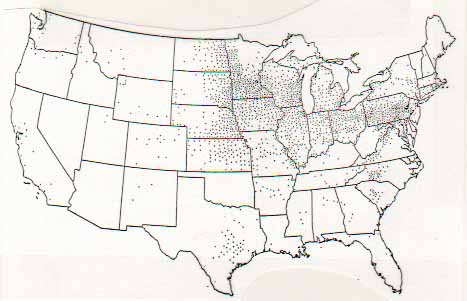
German Lutheran Churches in 1890
--- One Dot for Every Five Churches or Fraction Thereof- Following their initial concentrations in Philadelphia and Pennsylvania in colonial America, the Germans went due west. The map below of Lutheran churches is generally representative of the concentration of all German emigrants.
- The Schömbs emigrants during the 19th Century, some of whom were Lutheran and the balance Catholic, followed the traditional German patterns of location in the United States. They settled in New York, Pennsylvania, Ohio, Illinois and Kansas.
FOOTNOTES:
[1] Research Guide to German-American Genealogy, 929.3089 R311
[2] The Atlantic Bridge to Germany, 943 H14